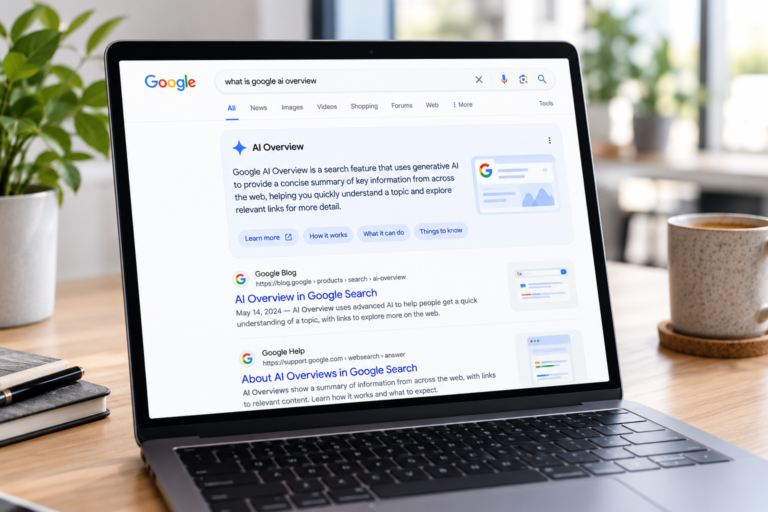
AI Overviews optimization means improving the accessibility, usefulness and evidence of your pages while checking whether Google includes them as supporting sources in AI-generated search answers. It is an extension of your search strategy, with its own observation process. It is not a separate submission programme or a guaranteed placement.
Start with questions that could lead to a purchase. A consulting firm needs visibility around choosing a provider, understanding scope and comparing approaches. Appearing for a broad definition may be useful, but it does not establish commercial impact.
The essential reference is clear: Google says there are no additional technical requirements or special optimizations for AI Overviews and AI Mode. Supporting pages need to be indexed and eligible for a search snippet. See Google’s documentation on AI features.
Build a useful baseline before editing
Choose twenty questions from sales conversations and Search Console queries. Keep the exact wording, country, language, device and observation date. Record whether an AI Overview appeared at all. A search without one is a different observation from an answer that appeared but omitted your brand.
01Eligibility
Can the page be indexed and shown with a snippet?
02Observed inclusion
Does the answer link to this page under recorded conditions?
03Business response
Do identifiable visits lead to relevant enquiries?
Crescendo’s audit framework. Inclusion and conversion require separate evidence.
For each answer, save a screenshot and the actual source URLs. Distinguish an owned-page citation, a brand mention and a recommendation. Your company might be mentioned through a third-party article without your website being linked.
Audit the answer, then the page
| Finding | What to inspect | Useful change |
|---|---|---|
| Your page is not eligible | Indexing, access and snippet controls | Resolve the documented obstacle with the technical owner. |
| Sources answer a narrower question | Scope, examples and conditions | Add the missing decision criteria to the relevant page. |
| Your claims have no supporting detail | Evidence, dates and authorship | Add a reproducible example or properly sourced finding. |
| Your source is cited but the offer is unclear | Service fit and next step | Explain who the service helps and what happens after an enquiry. |
Do not reproduce every heading used by a cited competitor. Identify what a buyer still needs to decide. If the question concerns outsourcing payroll across countries, useful detail includes the markets covered, handover responsibilities, exclusions and the information required for a quote.
A real editorial before-and-after from this guide
On 22 October 2026, we revised this article because its first version described an improvement without showing the finished output. The comparison below documents that editorial change. It is evidence of implementation, not evidence of a change in Google citations.
| Version | What the reader received |
|---|---|
| Original text | Add a comparison table, a documented research method and an example clearly marked as hypothetical. |
| Revised resource | The filled comparison below explains when translation or local keyword research is appropriate and what evidence to collect. |
| Decision | Translation-led starting point | Local keyword research required |
|---|---|---|
| Buyer need | The same service and decision are already validated in both markets. | Buyers use different terminology or compare different solutions. |
| Offer | Scope and availability are equivalent. | Service boundaries, requirements or buyer expectations differ. |
| Evidence to inspect | Existing market research and review by a local subject expert. | Local search results, query patterns and interviews with people serving the market. |
| Content action | Adapt the language and verify the local details. | Rework the page around locally validated questions and offer fit. |
This decision aid is an editorial framework. It is not a finding about a particular country. A market may need both translation and fresh research; the evidence determines how much adaptation is necessary.
What we can verify on Crescendo today
The AEO service page links to separate guides for AI Overviews, Gemini and Perplexity. Each guide gives the reader a different inspection task and a route back to the service. That structure is publicly checkable. Whether Google cites these pages requires a separate dated observation.
| Observation record | Required entry |
|---|---|
| Question | Exact wording and target country/language. |
| Result context | Date, device and whether an AI Overview appeared. |
| Evidence | Screenshot plus exact source URLs. |
| Interpretation | What was observed; no inferred ranking cause. |
| Follow-up | Page change, date and a comparable later observation. |
Our query fan-out guide helps identify adjacent questions to investigate before choosing the page structure.
Measure a sample without inventing market share
Suppose your team records 30 searches and an AI Overview appears in 18. Your domain is cited in 3 of those 18 answers. Report ‘3 of 18 observed AI Overviews cited our domain,’ alongside the 30-search sample. That is 16.7% of observed answers in this exercise, not 16.7% of all Google searches.
Repeat the same question set and keep the collection conditions visible. One screenshot is a snapshot. Changes in location, wording and the answer itself can change what you see.
Google includes AI-feature search traffic in overall Web performance reporting in Search Console. Do not label all growth on an edited page ‘AI Overview traffic’. Use a reporting dashboard to keep search trends, sampled citations and qualified enquiries distinct.
A practical first-month workflow
- Week 1: record the baseline and identify five pages tied to valuable questions.
- Week 2: check page eligibility and compare the answers with the information on those pages.
- Week 3: improve the two most important gaps, including examples and contextual internal links.
- Week 4: repeat observations, review search data and keep a dated change log.
This is a delivery schedule, not a ranking deadline. If you have too few observations to interpret a change, continue collecting evidence before declaring success.
Crescendo’s take
An ‘AI optimization’ package that mainly adds FAQs and a new file to your website is not enough. We would spend that budget on pages that help buyers evaluate your offer, with evidence they can check. Better answers deserve the work; guaranteed citations do not deserve your trust.
AI Overviews and AI Mode should not be treated as identical measurement environments. Our Google AI Mode SEO testing protocol explains experimental caveats, while entity SEO helps organize brand information that readers and systems can verify.
Frequently asked questions
Do I need separate content for AI Overviews?
Usually, improve the page that already owns the question. Create a new page when the intent is genuinely different, rather than publishing a parallel version for AI.
Does being cited guarantee more enquiries?
No. A citation can occur without a click, and a click can come from a reader who will never buy. Assess visibility and commercial outcomes separately.
Discuss an AI Overviews content review
Bring two priority pages and the questions you want them to answer. We can assess content gaps, evidence and the observation method. See the scope of our AEO work.
Discuss your AI search priorities
Published by Crescendo Agency. Sources checked on 22 October 2026. Hypothetical examples are labelled and do not represent client results.