
TL;DR
- Ask ChatGPT or Google AI Mode a question and the platform runs several hidden searches before answering. In AI Mode, one prompt can trigger 8 of them.
- Each fan-out query retrieves its own pages and sources; the final answer merges what all of them found.
- That gives your content several doors into one answer: a review, a price guide, a technical comparison, an article aimed at a specific buyer profile.
- Semrush tested this in a controlled experiment: 4 articles rewritten to target fan-out queries more than doubled their AI citations.
- A content plan built only on the visible prompt runs on incomplete information. The opportunities sit in the fan-out.
Query fan-out is the technique AI search platforms use to split a single prompt into multiple subqueries before generating an answer.
Each subquery pulls from its own source pool, and the response combines the results. For GEO, the consequence is direct: the prompt you see is only the entry point, and a content plan should be built around the fan-out queries behind it.
What query fan-out is
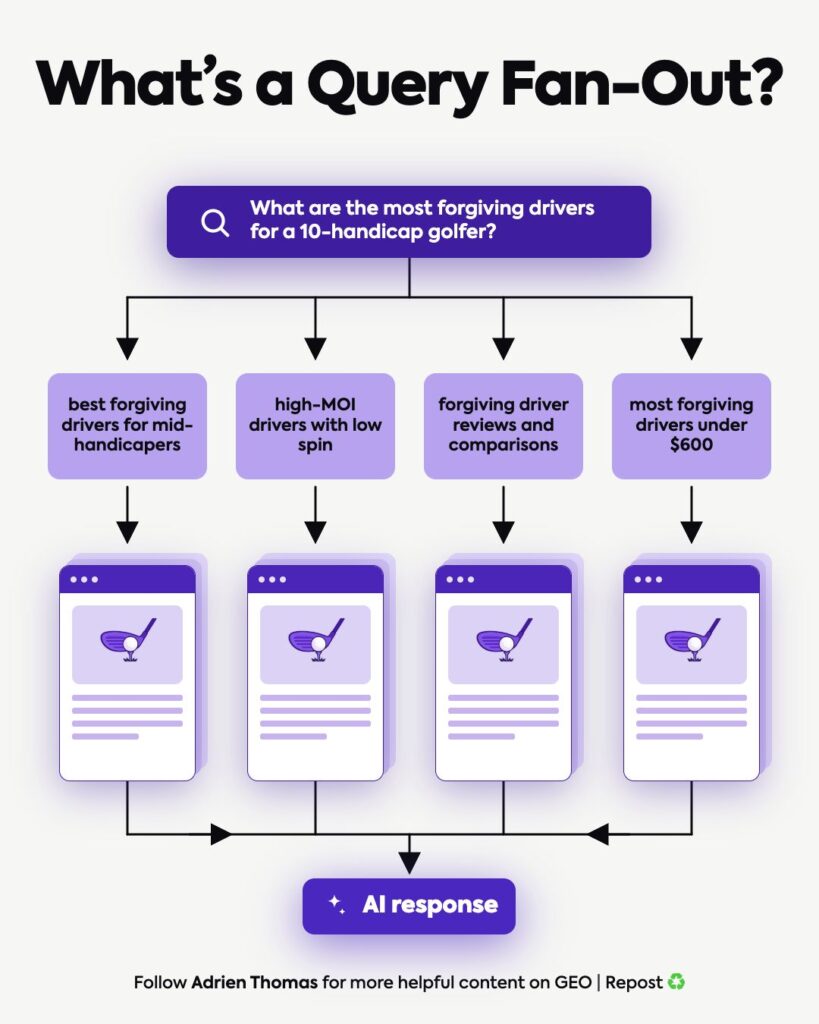
You ask ChatGPT one question. It runs several searches before it answers you. That’s query fan-out.
Google made the term official in May 2025 when it launched AI Mode at I/O. Google’s definition: an information retrieval technique that expands one query into multiple sub-queries to capture different possible user intents, then retrieves results from different sources, including the live web, the knowledge graph, and specialized data like Google Shopping.
A custom version of Gemini runs it, and the technique is active in AI Mode, Deep Search, and some AI Overviews.
Robby Stein, Google’s VP of Product for Search, gave the plain-language version: ask AI Mode about things to do in Nashville with a group, and the model writes its own follow-up questions about restaurants, bars, and kid-friendly activities, then runs those searches for you.
There’s a patent underneath (US11663201B2), where Google calls the mechanism “query variant generation.”
In practice, take the prompt: “What are the most forgiving drivers for a 10-handicap golfer?”
The AI might split it into 4 subqueries:
- Best forgiving drivers for mid-handicap golfers
- Forgiving driver reviews and comparisons
- Most forgiving drivers under $600
- High-MOI drivers with low spin
Each one retrieves a different set of pages, and the answer is assembled from the combined pool. AI Mode caps around 8 searches per prompt in the documented examples; research modes go far beyond.
Ahrefs documented ChatGPT Deep Research running 420 searches for a single product query. The volume changes by platform and mode. The principle holds everywhere: one query in, many queries out.
The queries themselves look different by platform too. Semrush’s own research found the average AI Mode query runs about 7.22 words, nearly double the roughly 4-word average for a classic Google search. Writing for fan-out means planning for that longer, more conversational phrasing, not just more of it.
Why the visible prompt is incomplete information
Each fan-out query has its own source pool, which changes what “being visible for a prompt” means. Your brand can enter the golfer answer through the original question, or through any of the subqueries behind it:
| Fan-out query | The page that answers it |
| Best forgiving drivers for mid-handicap golfers | A roundup written for mid-handicap players |
| Forgiving driver reviews and comparisons | Your review or comparison page |
| Most forgiving drivers under $600 | A price-bracket buying guide |
| High-MOI drivers with low spin | A technical explainer on MOI and spin |
Four subqueries, four doors into the same answer.
Semrush’s research backs the multi-door logic with data: appearing consistently across the underlying fan-out queries raises your chance of being cited in the AI response, even when you’re not the top result for the original prompt.
Their controlled experiment made it concrete. Four articles were rewritten to target their fan-out queries, and their AI citations more than doubled.
Retrieval also works at the passage level, not the page level. One section of your comparison guide can get pulled for a subquery while the rest of the page sits unused. Peec’s analysis of ChatGPT fan-outs landed on a blunt conclusion: content answering only one subquery has a lower chance of making the answer.
Your keyword tools show you none of this. A keyword is what a human types. Fan-out queries are machine-generated, written fresh for each prompt. The queries doing the retrieval work are ones you never typed and, by default, never see. Planning around the visible prompt alone means planning around one door.
What query fan-out changes for SEO

The subqueries get run through classic search, and the results get evaluated with ranking and quality signals before synthesis. AI Mode SEO and classic SEO share the same substrate: if your pages can’t rank for the subqueries, they can’t feed the answers either. Fan-out is the link between the two disciplines, and the reason “SEO is dead” keeps being wrong.
How we use fan-out queries at Crescendo
Fan-out queries are a core input for client content strategy at Crescendo, mapped and judged by the GEO team behind each account. The process runs in 4 steps:
- Identify the fan-out queries sitting behind the original prompt.
- Check which sources AI engines pull for each of them.
- Audit what’s already published.
- Map the gaps that still need covering.
Then the decision layer:
- What belongs inside the main article
- What earns its own cluster page
- How the pages connect through internal links
The judgment lives in that last part. The fan-out map shows what the AI is looking for. The content plan decides where each answer should live.
The mistake: stuffing everything into one article
The tempting shortcut is bundling every fan-out query into one 5,000-word page.
It will fail. A page trying to answer everything rarely answers anything deeply, and since retrieval happens per passage, a sprawling page with scattered ideas is harder for a model to pull from than a focused one with a clear answer per section.
Some questions belong as a section of the main article. Others carry enough intent of their own to need a separate page. The goal is covering the full buying decision across the right set of pages, each doing a specific job.
How fan-out connects to structure, hubs, and internal linking

If you’ve read my earlier SEO/GEO 101 posts, fan-out is the layer connecting them.
- Structured articles: every important fan-out query gets a clear answer inside the page.
- Content hubs: broader questions around the topic earn their own cluster pages.
- Internal linking: hub and cluster pages connect through relevant links and descriptive anchors.
Skip the internal linking step and even a well-mapped cluster plan risks producing exactly the kind of orphan pages that undo the rest of the work: pages that answer a real fan-out query but that nothing else on the site points to.
The full chain: main prompt → fan-out queries → content gaps → hub and cluster plan → structured articles.
The fan-out maps the related searches. The structure turns the map into pages AI engines and humans can use. The industry is settling on the same conclusion: Similarweb now frames topic clustering as the content response to query fan-out, with cluster pages built to cover the sub-query space an AI explores.
The problem: you can’t see the fan-out
In ChatGPT you see your prompt and the final response, but the searches between them stay hidden.
Workarounds exist:
- Browser extensions can intercept the network calls and expose subqueries
- Some tools simulate fan-out with Gemini.
Useful for single check, but they collapse as a tracking workflow: manual, per-conversation, impossible to run across a full prompt set.
That’s why we built fan-out visibility into Clairon. For each tracked prompt, you see the actual fan-out queries behind the answer. From there: which related searches sit behind the prompt, which topics the AI explores, which pages or sections are missing, and what to build next.
The prompt is the starting point. The content opportunities actually hide inside the fan-out.
Closing thought
Query fan-out changes the unit of work in GEO. The prompt is the entry point; the subqueries behind it define the content plan, deciding what becomes a section, what becomes a cluster page, and how everything connects.
At Crescendo, that’s how client content strategies get built: map the fan-out behind each priority prompt, find the gaps, turn the map into a hub and cluster plan.
Clairon is what lets us see those queries instead of guessing them. Process on one side, visibility on the other. For teams serious about AI visibility, that’s where the work starts.
FAQ
-
What is query fan-out?
An information retrieval technique where an AI platform splits one prompt into multiple subqueries, retrieves results for each, and merges them into a single answer. Google formalized the term with the launch of AI Mode in May 2025.
-
How many searches does one prompt trigger?
Platform and mode dependent. Google AI Mode can run 8 searches per prompt. Research modes climb much higher: Ahrefs documented ChatGPT Deep Research running 420 searches for one product query.
-
Why do fan-out queries matter for SEO and GEO?
Each subquery retrieves its own sources, so one prompt creates several paths into the answer, and the subqueries run through classic search with ranking signals intact. Semrush found that consistent presence across fan-out queries raises citation odds even without ranking first for the original prompt.
-
Can you see the fan-out queries behind an answer?
By default, no. Browser extensions intercept them for individual ChatGPT conversations, which works for spot checks. Systematic tracking across a prompt set needs a dedicated tool: Clairon shows the actual fan-out queries behind each tracked prompt.
-
Should you answer every fan-out query in one long article?
No. Retrieval happens at the passage level, and focused pages are easier for models to pull from than one page cramming everything. Closely related queries with short answers become sections; broader queries with their own intent earn cluster pages.