
The main difference between AEO and SEO is their focus: SEO improves discovery and qualified traffic through search, while AEO makes your information useful in direct answers, including AI-assisted search. They overlap. The same accessible, well-supported page can rank in Google, answer a specific question and become a cited source.
If you are deciding where to invest, start with the bottleneck: pages that cannot be found, answers that do not satisfy buyers, or traffic that fails to convert. This guide compares the work, shows concrete examples and explains how to measure both without counting an AI mention as a website visit.
AEO vs SEO: comparison at a glance
| Question | SEO | AEO |
|---|---|---|
| What does it mean? | Search engine optimization. | Answer engine optimization. |
| Main objective | Help relevant audiences discover your pages through search. | Help your information answer audience questions clearly and accurately. |
| Where can it appear? | Organic search results and search features. | Direct answers, answer-led search features and AI responses. |
| Typical work | Technical SEO, intent research, useful content and internal links. | Question research, clear explanations, comparisons and evidence review. |
| What should you measure? | Impressions, clicks, query coverage and qualified conversions. | Observed mentions and citations, identifiable referrals and qualified conversions. |
| What is shared? | Accessible pages, accurate facts, relevant links and content that helps people make decisions. | |
What is the biggest difference between SEO and GEO? This short video explains why other websites, not your own claims, decide whether ChatGPT recommends you.
What is SEO?
SEO helps search engines discover and understand your pages, and helps searchers choose them. It covers technical access, content relevance, site structure and how a result represents the page. A useful SEO programme connects those tasks to enquiries or sales.
For example, an accounting firm might create a page answering “how much does company incorporation cost?” Its work includes explaining the fees and exclusions, linking from relevant service pages, and checking which queries bring impressions and clicks. A higher position matters when it brings the right visitors.
What is AEO?
AEO focuses on answering the questions people bring to search engines and assistants. It can include definitions, troubleshooting, comparisons and explanations of who a service suits. A useful answer gives the conclusion early, then the context needed to trust and apply it.
In a generated answer, a business can be named without its website being linked. A page can also be cited without the brand being recommended. Neither outcome automatically produces a click. If you are evaluating outside help, our guide explains what an AEO agency does and which deliverables to request.
New to answer engine optimisation? Ahrefs’ seven-minute kickoff covers what AEO is and how to get cited in AI Overviews and ChatGPT.
AEO vs SEO vs GEO: how the terms fit together
GEO stands for generative engine optimization: work focused on how brands and sources appear in generated answers. AEO is also used for direct-answer experiences beyond generative AI. In practice, agencies often use AEO and GEO for overlapping services, so compare their actual work and measurement rather than the acronym.
SEO remains relevant to AI search. Google’s guidance on AI features says its existing SEO practices apply to AI Overviews and AI Mode. It does not require a special AI text file or special schema. Treat llms.txt and its limitations as a separate implementation question, not a prerequisite for an AEO strategy.
Five practical examples of SEO and AEO working together
1. Answer a pricing question completely
Replace a vague paragraph with actual pricing information your business can stand behind: what is included, what changes the quote, and which costs are additional. Where a fixed price would be misleading, show a worked example and label its assumptions. That helps both a search visitor and a system retrieving an answer.
2. Make a comparison useful before asking for a sale
Use consistent criteria across the options: intended audience, limitations, implementation effort and total cost. Explain your commercial relationship to any product. Our comparison of AI visibility tools illustrates how to assess monitoring software without treating every dashboard score as equivalent.
3. Turn a vague FAQ into a decision aid
Instead of “Do you offer international services?”, answer which countries you cover, which languages are supported and where specialist advice is needed. Use a descriptive question heading and a direct answer followed by necessary detail. There is no universal word count or FAQ markup that guarantees selection.
4. Connect an article to the next useful page
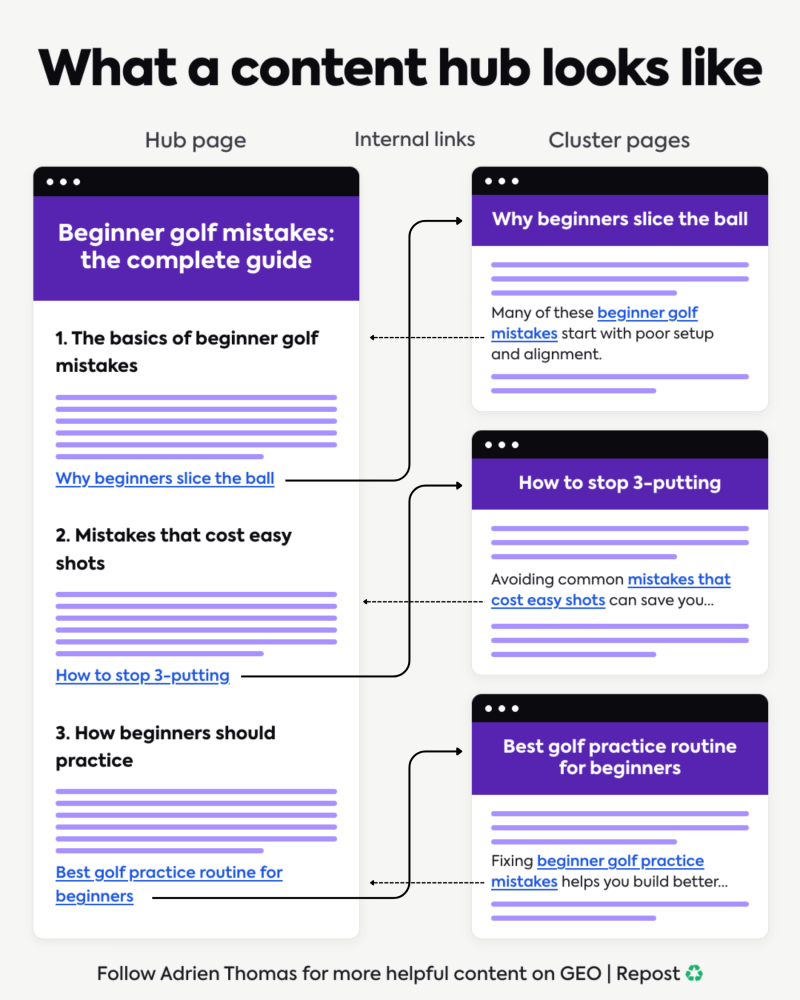
A guide about choosing a provider should link to a relevant service page; that service page can link back to the guide where readers need detail. Review pages without incoming internal links so useful content is reachable from established parts of the site.
5. Check what third-party sources actually say
Review the sources cited in observed answers. Correct inaccurate business details where you control them and seek legitimate coverage where relevant. The presence of a competitor on a cited page is a research lead, not proof that buying a mention will reproduce the result.
How to measure SEO and AEO
Keep three reporting layers separate:
- Google search performance: page and query impressions, clicks, CTR and average position in Search Console.
- Observed AI visibility: mentions, citations and competitor presence for a defined prompt sample, with platform, market and date recorded.
- Business outcomes: identifiable referral sessions, enquiries and sales, with attribution limits documented.
Google includes traffic from its AI search features within Search Console’s Web reporting. A prompt tracker is a different dataset; its visibility percentage is not the percentage of all potential customers who saw your brand. Use our guide to tracking AI traffic to connect identifiable visits with on-site outcomes.
For implementation, our AEO agency programme brings question research and page improvements into one work plan. A business entering another country may also need international SEO services; a Bangkok business can coordinate this with local and national SEO in Thailand. The choice follows the audience and workload, not the number of labels in a proposal.
Where should you invest first?
| Your situation | First priority | What to review next |
|---|---|---|
| Important pages are hard to find or access. | Technical access and relevant internal links. | Discovery, indexing and impressions. |
| Pages receive impressions but few clicks. | Query intent, title, opening answer and search-result competition. | CTR alongside position and query mix. |
| Visitors arrive but do not enquire. | Offer clarity, evidence, pricing context and next steps. | Qualified conversion outcomes. |
| Buyers compare suppliers in AI tools. | Monitor relevant questions and improve missing or inaccurate answers. | Repeat observations and identifiable referrals. |
There is no defensible universal SEO/AEO budget percentage. Fund shared work once, then add research and monitoring where they answer a business question. Our GEO audit checklist helps turn that diagnosis into a prioritised work queue.
A practical 90-day action plan
Days 1–30: record a baseline, choose priority pages and buyer questions, and fix access or factual problems. Give each page a clear purpose and identify relevant incoming links.
Days 31–60: improve the selected pages, add examples and decision criteria, and publish contextual links. Record each change so later reporting has a reliable timeline.
Days 61–90: compare search performance with the baseline and repeat AI observations under comparable conditions. Investigate which queries and pages improved. This is a review schedule, not a promise that rankings or leads will change within 90 days.
For B2B teams choosing an implementation partner, our B2B GEO agency guide includes a vendor scorecard and three practical examples connecting buyer questions to page improvements.
Frequently asked questions
Is AEO replacing SEO?
No. Answer-focused content and search optimisation share the same website and many of the same tasks. Coordinate them around audience questions and business outcomes.
Is AEO better than SEO?
That depends on the problem. Search traffic, answer visibility and conversions are different outcomes. Start with evidence of where prospective customers are being lost.
Does schema guarantee an AI citation?
No. Structured data should accurately describe eligible visible content. It does not force an assistant to cite or recommend your business.
Do I need separate pages for SEO and AEO?
Usually not when the audience and intent are the same. Improve the strongest relevant page instead of creating near-duplicates with different labels.
Need help choosing the first pages to improve? Explore Crescendo’s AEO services and discuss your search traffic, buyer questions and implementation priorities.