
An entity is not a keyword; it is a recognizable thing whose identity and relationships can be described consistently.
CRESCENDO / PRACTICAL SEO FRAMEWORK
Four signals of a credible brand entity
An editorial decision framework, not a guaranteed ranking formula.
1
IDENTITY
Consistent company facts
2
EXPERTISE
Verifiable specialization
3
CORROBORATION
Independent references
4
COMMERCIAL PROOF
Real outcomes and examples
Imagine two consulting firms. Both claim to be specialists in international SEO. One has only a sales page. The other has a consistent company name, clear leadership, named expertise, published methods, independent mentions and case studies that can be verified. These signals do not guarantee higher rankings or AI recommendations, but they give search systems and buyers more reliable context.
That is the useful version of entity SEO: improving how clearly a real organization, person, service or product can be understood and distinguished from similarly named things.
Entity SEO versus traditional keyword SEO
Keyword research examines the words people type. Entity work examines the real-world objects behind those words and their relationships. A B2B agency might connect its brand to a founder, industry topics, services, clients, locations, original research and professional profiles. The objective is coherent information, not repeating the organization name hundreds of times.
1. Make your organization identifiable
Start with the public basics: legal or trading name, a consistent brand description, official website, contact details, primary services, regions served, leadership and an accessible About page. Avoid describing a company one way on its homepage and another way on key directories.
Google’s Organization structured-data documentation explains that markup can help it understand administrative details and disambiguate organizations. This does not mean schema creates trust or guarantees a Knowledge Panel. Google documentation.
2. Give expertise a verifiable author
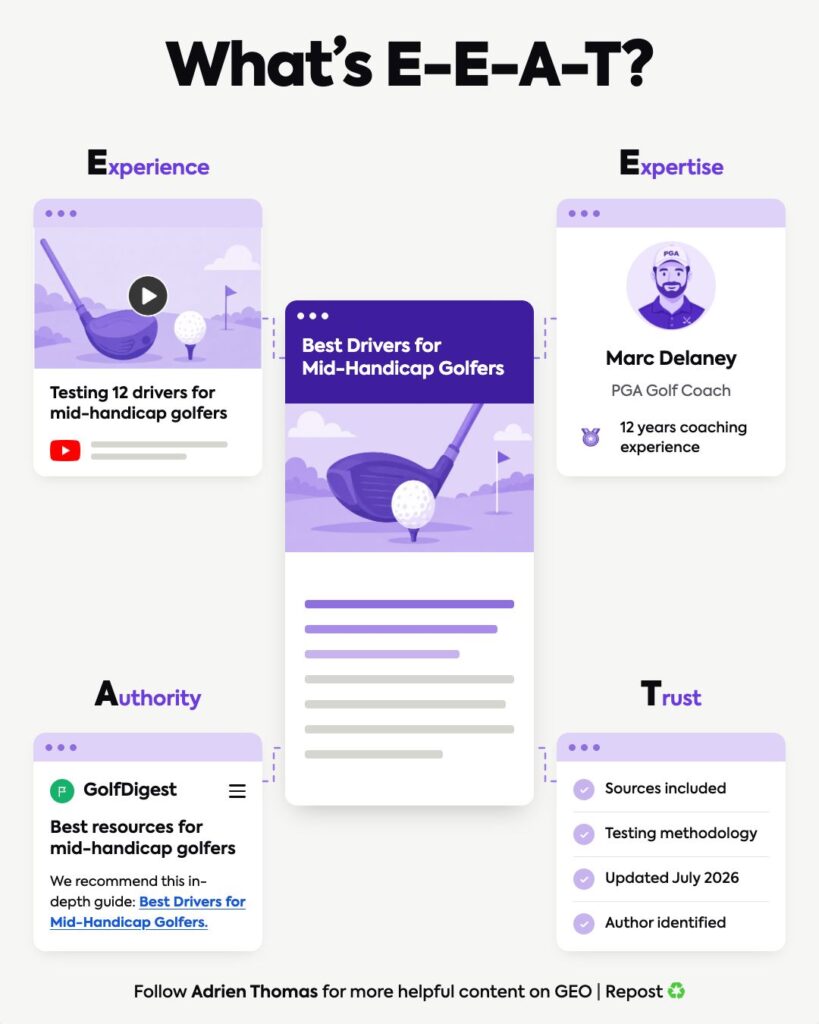
When publishing guidance, identify who is responsible for it and why the reader should trust their experience. Link author bios to real projects, research or public work when disclosure is appropriate. Cite primary documents when making technical or policy claims.
A generic “reviewed by experts” statement without named, verifiable reviewers adds little. Author names should reflect genuine contribution.
3. Build real external corroboration
Seek independent professional coverage and useful citations: conference talks, industry associations, original studies, research contributions, expert interviews and authentic customer references. These are useful because third parties can evaluate them, not because a directory listing mechanically produces an SEO score.
Do not buy invented reviews, fabricate testimonials or mass-create fictitious external profiles. Independent evidence must be independent in substance, not only in URL.
4. Connect content hubs to specific expertise
Map each core service to its supporting questions, comparisons, workflows and case studies. The service page explains what the business offers. Educational pages explain the problem, who should care and the trade-offs. Internal links make the relationship visible to readers without treating links as a substitute for substance.
For an AI visibility specialist, a coherent cluster might include an AI visibility audit, brand monitoring, citations versus mentions and performance measurement, each with a distinct job.
5. Use structured data accurately
Where relevant, add Organization markup and connect trustworthy public profiles via sameAs. Only use factual properties that match visible site content. Validate output and maintain it after rebrands, mergers and location changes. Schema helps describe, not certify, your business.
The Crescendo Entity Evidence Map
We recommend a four-layer inventory: identity, expertise, independent corroboration and commercial proof. For each layer, record the URL, owner, freshness, verification method and missing evidence. This is an original operating framework, not a Google ranking factor and not a promise of AI citation.
| Evidence layer | Practical asset | How to validate |
|---|---|---|
| Identity | Organization page and consistent profiles | Match official business details |
| Expertise | Named author, method and topical hub | Verify authorship and sources |
| Corroboration | Independent coverage or associations | Confirm publisher and context |
| Commercial proof | Consent-based case study | Validate time period and metric definitions |
The Crescendo Take: consistency should lead to distinguishability
We would rather have five strong, independently checkable references than 100 boilerplate listings. Buyers looking for expert advice need to know who is accountable, what they actually do and what evidence supports the promise. That same discipline makes content easier to interpret across search experiences.
FAQ
Is entity SEO the same as adding schema?
No. Structured data describes information; entity strategy also includes consistent public identity, accurate content and independently verifiable evidence.
Will Organization markup make my company appear in ChatGPT?
There is no guaranteed relationship. Use it to help describe the organization accurately, then measure brand appearance separately.
Should every article have a named author?
For expert guidance, transparent authorship is often useful. Only identify genuine contributors rather than inventing authority badges.
Next step
Explore AI brand mentions versus citations and Crescendo’s AI visibility approach to connect brand evidence with the right measurements.