
Most SEO content strategy advice is written for teams that don’t exist. The playbook assumes a writer, an editor, a designer, and someone free to ship five posts a week. If your entire team is two founders and a freelancer who answers Slack on Fridays, that plan is fiction.
We’ve audited dozens of lean content operations, and the pattern is boringly consistent: the strategy is usually fine. The failure is capacity.
A team of 1–3 people with no dedicated writer can realistically ship 4 to 8 substantial pages in 90 days – not 40. So this 90 day SEO content plan is built around that number, and it says out loud what you should deliberately not do.
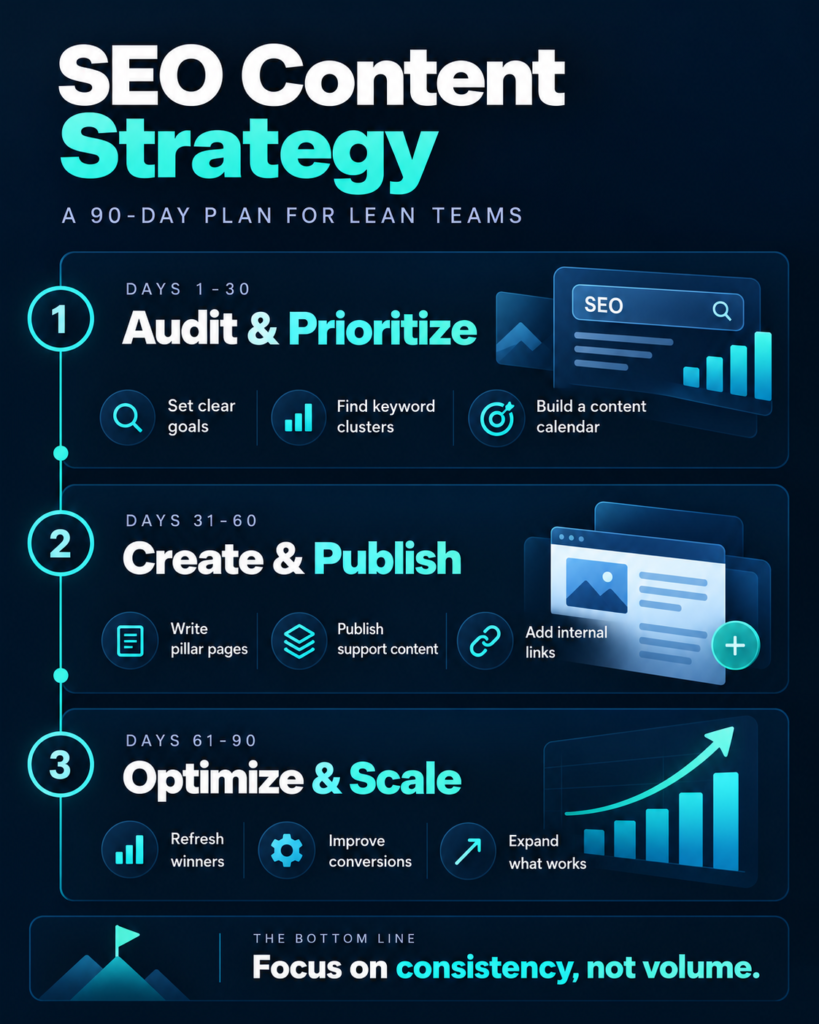
Key takeaways
- Capacity beats strategy. A lean team ships 4–8 quality pages per quarter. Plan for that, or plan to fail.
- Refresh before you build. Refreshing pages that already rank is almost always faster ROI than launching a new blog from zero.
- Pick 3 topics, not 30. Depth on three subjects beats shallow coverage of thirty.
- Every page needs a conversion path and internal links before it goes live – not after.
- Measure at day 90 with rankings, non-brand traffic, and conversions. Ignore vanity impressions.
The Constraint Most Plans Ignore: Capacity
A 90-day editorial plan becomes more coherent when articles follow deliberate content hub architecture rather than stand alone.
Search results for “SEO content strategy” are crowded. Brafton, HubSpot, Moz and SiegeMedia all publish 5,000-word pillars that rank well and assume a content department. The 90-day playbooks that exist are solid too – but they’re written for teams that can parallelise work.
Lean teams can’t parallelise. One person doing keyword research is not doing writing. That’s the whole constraint, and no amount of tooling removes it.
The fix isn’t a productivity hack. It’s a smaller plan you can actually finish.
What a Lean Team Can Realistically Produce
Run the math honestly before you commit to anything.
- A well-researched, 1,500-word page takes 6–10 hours including research, drafting, and editing.
- A refresh of an existing page takes 2–4 hours – faster because the structure exists.
- A 10-hour-per-week content budget gives you roughly one new page or three refreshes per week.
So in 90 days, a two-person team working 10 hours a week between them can produce something like 2 refreshed pages plus 1 new page per week. That’s about 24 refreshed pages and 12 new pages if every single week lands. It never lands every week. Plan for 60–70% of that and you’ll have a plan you can keep.
The Build vs. Refresh Split
Here’s the ratio we recommend for almost every lean team: 70% refresh, 30% new.
Why so lopsided? Because a page ranking at position 14 with a few backlinks is one good edit away from page one. A brand-new page starts at zero and needs months to crawl, index, and earn any authority at all.
Ahrefs has documented the effect directly: in one published example, updating existing pages produced an average 72% traffic increase across the updated set. That’s a specific case, not a guarantee – but the direction is consistent with what we see. If you already have 40+ published posts, your fastest win isn’t writing. It’s editing.
Before Day 1: The 5 Inputs You Need
Don’t start the clock until you have all five of these. Skipping any one of them turns the next 90 days into guesswork.
- Revenue-driving topics. List the questions customers ask on sales calls. Not what you think they search – what they actually ask. A content strategy for small teams lives or dies on this list being real.
- Current ranking baseline. Export every keyword where you rank positions 4–20 from Search Console. These are your easiest wins and your prioritisation pool.
- Competitor content gaps. Find the topics two or three competitors rank for that you don’t cover at all. Ignore their entire blogs – just the gaps.
- Existing content inventory. Every URL, its publish date, its organic traffic trend, and its conversion rate. One spreadsheet. No exceptions.
- One clear conversion goal. Demo request, trial signup, newsletter, consultation booking. One. If the answer is “all of them,” you don’t have a goal.
Days 1–30 – Audit and Prioritise
Month one produces zero new content. That’s intentional. You’re deciding where to spend the next 60 days.
Not sure where your site is stuck? Our co-founder walks through a simple diagnostic framework to find what is holding back your Google growth before you spend on new content.
Inventory Every Existing Page
Pull every URL into a single sheet. For each one, log:
- URL and title
- Publish and last-updated dates
- Organic sessions, last 90 days
- Primary keyword and current position
- Conversions attributed (form fills, demo requests, whatever your goal is)
- Internal links pointing to it
Yes, this is tedious. Do it anyway. We’ve seen teams skip the inventory, then spend $4,000 writing a new guide that duplicates a page already ranking at position 9.
Score by Traffic, Conversion and Decay
Now score each page 1–5 on three axes:
- Traffic – how much organic traffic it brings today.
- Conversion – how many goal completions it drives.
- Decay – how much traffic it has lost versus its peak.
Any page scoring high on traffic and decay is a refresh priority, no debate. It already proved it can rank; it just went stale. Pages with traffic but zero conversions need a conversion path, not more words.
Pick 3 Topics, Not 30
Once the audit is done, choose three topic clusters for the quarter. Not thirty keywords – three topics.
A topic cluster is a subject where you can publish a pillar page and support it with related pages. “Business bank account opening” is a topic. “Bank account fees in Singapore” is a keyword. Lean teams survive on clusters because each page reinforces the others.
Use the data you pulled in the audit: the 720 monthly searches behind a commercial term like “SEO content strategy” with a $14.81 CPC tells you buyers are searching. Volume alone doesn’t. Intent does.
Define the Content Format for Each
Before anyone writes a word, decide the format: how-to guide, comparison, checklist, template, or data breakdown. Match the format to what already ranks on page one for your target query. If the top 10 results are all step-by-step guides, a thought-leadership essay won’t crack it.
Lock the format in a brief. One page per piece, with target keyword, H2 outline, internal links to include, and the conversion CTA. A brief takes 30 minutes and saves three hours of rewrites.
Days 31–60 – Build and Refresh
Now you ship. Months two is the only part of this plan where output matters.
The Refresh-First Rule
Do every refresh before you write a single new page. No exceptions.
Refreshes compound faster. They hit already-indexed URLs, keep existing backlinks, and often recover traffic within 2–4 weeks. New pages sit in limbo for 6–12 weeks minimum.
A refresh checklist that takes under an hour:
- Update the publication date and add “Last updated” where relevant.
- Answer the question in the first 100 words – don’t bury it in paragraph six.
- Add any subtopics the current top-ranking competitors cover that you don’t.
- Fix internal links: in, out, and anchor text.
- Re-check every statistic and add the source.
- Add or improve the conversion CTA.
One Pillar, Three Supporting Pages
For each of your three topics, build one pillar page – the broad, definitive resource – and three supporting pages that go deep on specific sub-questions.
Structure matters more than volume:
- The pillar covers the whole topic at a high level and links out to all three supporting pages.
- Each supporting page links up to the pillar using descriptive anchor text.
- Supporting pages also link to each other where genuinely relevant.
This is the cheapest authority you can build. It costs nothing and it tells Google – and AI engines – exactly what your site is about.
Optimising for AI Answers, Not Just Blue Links
A growing share of your future traffic never clicks a blue link. It reads an AI answer and moves on. Optimising for that isn’t a separate discipline from SEO – it’s an extension of it.
Google’s own guidance is blunt: there’s no special markup or trick for AI features. Pages need to be crawlable, eligible for snippets, and genuinely useful – the same fundamentals. What changes is how you structure the answer.
Practical moves that work for both:
- Answer in the first 100 words. State the conclusion, then explain.
- Use question-shaped H2s and H3s. AI engines lift headings as answer scaffolding.
- Attribute claims to named sources. Uncited assertions get skipped.
- Keep facts and dates current. Stale pages lose citations first.
- Make authorship and expertise visible. Google’s raters explicitly weight experience and trust.
If you want the deeper mechanics, our LLM SEO guide walks through how models actually select sources, and our AEO services cover the execution layer. For a self-serve starting point, the answer engine optimization tools comparison shows what each platform can and can’t measure.
Wondering how AI answers change your content plan? Ahrefs shares how it would approach ranking in Google in the AI era, including what its data shows about AI Overviews and clicks.
Choose the commercial destination before writing each supporting brief. A country launch checklist can support international SEO implementation; a comparison of AI-search suppliers can support B2B GEO agency selection; an answer-led content guide can lead to AEO services. The link should resolve the reader’s next question, with an anchor that accurately describes the destination.
Internal Linking as Part of the Plan
Internal links are the most under-used lever in lean content operations – probably because they’re invisible in most reports.
Rule for the quarter: every new or refreshed page ships with at least three internal links pointing to it, and at least two pointing out. Add them in the brief, not after publishing. If a link isn’t in the brief, it won’t happen.
Keep anchor text descriptive. “Read our guide on Hong Kong company registration” beats “click here” every time.
Days 61–90 – Measure and Double Down
Month three is half execution, half judgement. You’re deciding what survives into next quarter.
What to Measure at 90 Days (and What Not To)
At day 90, look at four things:
- Non-brand organic sessions to refreshed and new pages.
- Keyword position movement for the specific target terms in your briefs.
- Conversions – goal completions attributed to those pages.
- AI citation presence – whether your brand appears in answers for your target prompts.
What to ignore: total impressions, social shares, average time on page, and any single-day spike. None of them tell you whether the plan worked.
Be honest about timing. Content Marketing Institute’s 2025 B2B benchmark research found 74% of B2B marketers said content marketing helped generate demand or leads over 12 months – but 56% still cite attributing ROI as a challenge. Ninety days gives you directional signals, not a finished ROI story.
Kill or Fix Decisions
Every page in the audit gets one of three verdicts:
- Double down – working, expand or update quarterly.
- Fix – has potential, needs a specific intervention (new intro, better CTA, more depth).
- Kill – no traffic, no conversions, no rankings after 12 months, and no backlinks. Redirect it to a relevant page.
Killing pages feels wasteful. It isn’t. It removes cannibalisation and concentrates authority where it earns something. Most lean teams should kill or consolidate more than they do.
Setting Up the Next Quarter
Write the Q2 plan before day 90 ends, while the data is fresh:
- Which cluster produced the most conversions? Do more of that.
- Which format underperformed? Drop it.
- Which three topics are next? Same structure: one pillar, three supporting pages.
The 90-day cycle works because it’s repeatable. Run it four times a year and you have a real content engine built by two people.
The 90-Day Plan at a Glance
| Week | Focus | Deliverable | Owner | Success signal |
|---|---|---|---|---|
| 1–2 | Audit and inventory | Full URL inventory with traffic, conversion and decay scores | Strategist / founder | Every live URL is scored |
| 3–4 | Prioritisation | 3 topic clusters + content briefs locked | Founder | Scope frozen, formats decided |
| 5–7 | Refresh sprint | 6–9 refreshed pages live with updated CTAs | Generalist | Rankings hold or climb within 3 weeks |
| 8–9 | Pillar build | 1 pillar page published and internally linked | Freelancer + editor | Indexed within 7 days |
| 10–11 | Supporting pages | 3 supporting pages live, all linking to pillar | Freelancer + editor | All internal links resolve |
| 12 | Measure and decide | 90-day report + Q2 plan | Founder | Verdict on every audited page |
What to Deliberately Not Do
This list matters more than the plan itself. Every item here has sunk a lean team we’ve worked with.
- No 50-post content calendar. You cannot execute it. Its only function is to make you feel behind by week three.
- No new blog from scratch if you have 40 decaying posts. Fix what ranks before you build what doesn’t exist.
- No keyword-volume-only prioritisation. Search volume without commercial intent is a traffic problem dressed as a growth strategy.
- No content without a conversion path. A page with no CTA is a brochure. Decide the next step before you write the first sentence.
- No publishing without internal links. Unlinked pages are orphaned pages. Google finds them late, ranks them lower, and AI engines often skip them entirely.
- No more than three topics. If your plan needs a legend to read, it’s not a lean plan.

Use Case 1 – Two-Person Team Refreshes 18 Pages and Doubles Non-Brand Traffic
Illustrative scenario based on patterns we see in client audits.
A two-person B2B services team – one operations lead, one part-time marketer – came in with 86 published blog posts and flat organic traffic for 14 months. They were about to hire a freelancer to write eight new posts a month.
We stopped them.
The audit found 31 pages that had once ranked in the top 20 and had since slipped past position 30. Backlinks were still intact. Content was simply outdated – prices from 2022, dead screenshots, missing subtopics.
Over 90 days, working roughly 10 hours a week between them, they refreshed 18 pages:
- Rewrote intros to answer the core question in the first 100 words.
- Added two inbound and two outbound internal links to each page.
- Updated every figure and added sources.
- Added a single, consistent CTA to a consultation booking form.
Result at day 90: non-brand organic sessions roughly doubled, and 9 of the 18 pages returned to the top 20 for their target terms. They published zero new posts during that window. The freelancer hire was postponed by a quarter.
Use Case 2 – Solo Founder Learns the Hard Way That Volume Is Not Strategy
Illustrative scenario based on patterns we see in client audits.
A solo founder in SaaS committed to publishing three posts a week. For six months he shipped 72 articles, most of them 800–1,200 words with keyword-optimised titles pulled straight from a volume tool.
Traffic after six months: up 18% in aggregate, almost all of it branded or low-intent.
Three problems, none of them about writing quality:
- Zero internal links. Every post was effectively orphaned. He never linked one to another.
- No conversion path. No CTA on 60 of the 72 posts.
- Volume-only prioritisation. Topics chosen for monthly search volume with no commercial intent behind them.
He had built a content library, not an SEO content plan. The recovery took two quarters: consolidating 22 near-duplicate posts into 6 stronger pages, adding internal links across the archive, and killing 14 pages with no traffic and no backlinks.
Lesson: 72 posts is not 72 assets. Six months of output produced less than what a focused 30-day refresh would have.
How Crescendo Builds Content Plans for Lean Teams
We don’t start with a keyword list. We start with your capacity – how many people, how many hours, and who actually writes.
From there, our process runs in four steps:
- GEO and SEO audit. We benchmark where you stand on Google and across AI platforms, so the plan covers both surfaces. The GEO audit checklist shows the exact inputs we collect.
- Prioritisation model. Every URL and topic gets scored on traffic, conversion and decay. Output is a ranked list, not a spreadsheet you have to interpret.
- Scoped execution plan. Three clusters, defined formats, fixed weekly hours, and an explicit not-to-do list.
- Tracking. Monthly reporting on rankings, non-brand traffic, conversions, and AI citation presence.
The scope adapts to the team. For a solo founder we build a 6-hour-a-week plan. For a team of three, we build a 20-hour one. The structure doesn’t change – the volume does.
Crescendo’s Take
Publishing frequency is the most overrated variable in content marketing. We’ve never seen a lean team lose because they published once every two weeks. We’ve watched plenty lose because they published twice a week and never linked, never updated, and never measured.
To most lean teams, we say: stop publishing new posts for 60 days. Not forever – 60 days. Take that capacity and put it into your existing library. Fix the pages that already rank, add the internal links you skipped, and put a conversion path on everything. Then measure. In our experience the refresh quarter outperforms the writing quarter more often than not, and it costs a fraction of the effort.
With a 10-hour-per-week content budget, here’s exactly what we’d do. Six hours on refreshes – two pages a week. Two hours on internal linking and brief writing. One hour on measurement. One hour on planning next month. Zero hours on new pillar content until month three, when the pillar gets a full three-week slot. That’s it. Boring, repeatable, and it works.
If you’d rather not run it yourself, that’s what our AEO services are for.
Choose topics around commercial decisions
For the prioritization stage, use our B2B SEO strategy framework to connect each proposed page to a buyer and an offer. Recruitment businesses can use this sector-specific SEO plan to keep employer acquisition separate from candidate content and measurement.
A content publishing workflow should also review meta descriptions for important pages whose search snippets could be more compelling.
FAQ
How many blog posts should a lean team publish in 90 days? Plan for 4 to 8 new pages and 10 to 20 refreshes. That’s realistic for 1–3 people working about 10 hours a week. Anything above 12 new posts requires either a dedicated writer or a very low quality bar.
Should I refresh old content or write new content first? Refresh first, always. Already-indexed pages with existing backlinks respond in 2–4 weeks. New pages take 6–12 weeks to gain traction. Do every refresh before you write anything new.
What’s the difference between an SEO content plan and an SEO content strategy? A strategy defines who you’re targeting, which topics, and why. A plan defines what ships, when, and by whom. Lean teams need both, but the plan is what actually gets executed. If you only have time for one, write the plan.
How many topics should a small team target per quarter? Three. Each with one pillar page and three supporting pages. Any more and you dilute effort across too many clusters to rank meaningfully for any of them.
Do I need a dedicated writer to do this? No – but you need someone with 6–10 uninterrupted hours a week. Founders, ops leads, and generalist marketers all work. The failure mode isn’t skill; it’s fragmentation.
How do I know at day 90 if the plan worked? Look at four numbers: non-brand organic sessions, position changes on your target keywords, conversions from refreshed and new pages, and AI citation presence. If non-brand sessions are up and at least a third of your target keywords moved, the plan worked. If not, your topics were wrong – not your effort.