
Key Takeaways
- The case for generative engine optimization is now backed by published data on usage, adoption, conversion, and revenue.
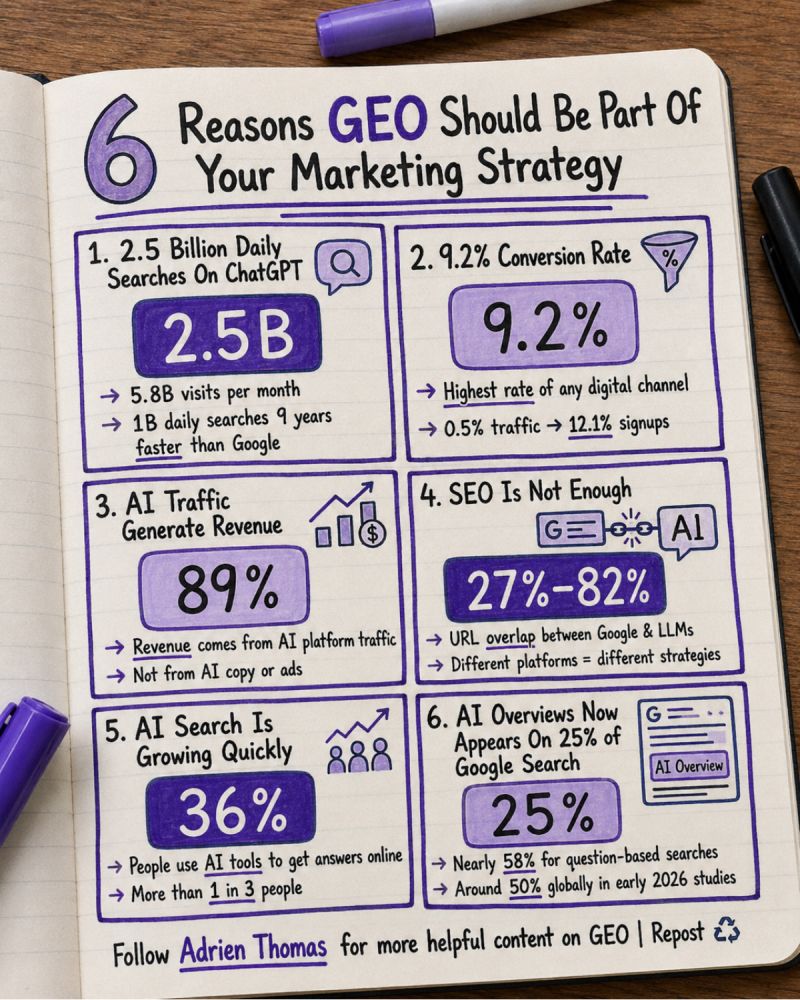
- ChatGPT handles 2.5 billion prompts a day, and an AP-NORC poll found 60% of U.S. adults have used AI to search for information.
- AI referral traffic is under 1% of most sites’ visits, yet it converts far better than other channels. At Ahrefs, 0.5% of traffic brought in 12.1% of signups.
- Your Google rankings don’t carry over. Ahrefs found only 12% of links cited by ChatGPT, Gemini, and Copilot rank in Google’s top 10 for the same query.
- SEO stays the foundation. GEO decides whether that visibility reaches the AI answers your buyers read first, and one quarter is enough to get a baseline in place before 2027.
Generative engine optimization (GEO) is the work of getting your brand mentioned and cited in AI-generated answers, on ChatGPT, Gemini, Perplexity, and Google’s AI Overviews. By late 2026, the data makes the case on its own.
AI platforms handle billions of queries a day, and the traffic they send converts better than most channels. Showing up there also works differently from ranking on Google. GEO doesn’t replace SEO, and Google is still the biggest source of demand.
What Is Generative Engine Optimization (GEO)?

Generative engine optimization covers what makes AI platforms pick your brand when they answer a question: the content on your site, how it’s structured, and what third-party sources say about you. You’ll also see it called AI search optimization, AEO, or LLMO. Whatever the name, the goal is to appear inside the answer, as a mention or a cited source.
The term comes from a 2023 research paper, “GEO: Generative Engine Optimization,” by Pranjal Aggarwal and co-authors. It was published at the KDD 2024 conference. The researchers tested ways to make content more visible in AI answers. They found that GEO methods “can boost visibility by up to 40% in generative engine responses.”
For a marketing team, that makes GEO a new channel, with its own tracking and its own competitors. Here are 4 reasons it belongs in your plan now.
Reason 1: AI Search Is Now Mainstream Behavior
ChatGPT receives 2.5 billion prompts a day, a figure OpenAI gave Axios in July 2025. In late February 2026, OpenAI announced that ChatGPT had reached 900 million weekly active users.
Across all AI platforms, a Graphite.io study counts around 45 billion sessions a month. That’s roughly 56% of worldwide traditional search volume.
Surveys show your customers are part of that volume:
- An AP-NORC poll of 1,437 U.S. adults in July 2025 found that 60% have used AI to search for information, rising to 74% among people under 30.
- Eight Oh Two’s 2026 AI and Search Behavior study found that 37% of consumers now start their searches with AI tools like ChatGPT instead of a search engine.
Your buyers already ask AI about your category. What you may not know yet is whether your brand shows up in the answers.
Reason 2: AI Traffic Is Small, but It Converts Better Than Other Channels
Most marketing teams underrate this channel because the volume looks small. Microsoft Clarity analyzed more than 1,200 publisher and news sites and found that AI platforms still bring less than 1% of overall traffic. In a budget meeting, that number often ends the discussion.
The conversion numbers tell a different story. Ahrefs shared its own data: 0.5% of its traffic came from AI search, and that traffic brought in 12.1% of its signups. By Ahrefs’ count, AI search visitors convert 23 times better than traditional organic search visitors.
The same pattern shows up wherever the data gets published:
- Microsoft Clarity found AI referrals converting at roughly 3 times the rate of other channels across those 1,200+ sites.
- Seer Interactive measured ChatGPT referral traffic converting at 15.9%, against 1.76% for Google organic traffic (June 2025).
- Adobe Digital Insights found AI traffic to U.S. retailers converting 42% better than non-AI traffic in March 2026. A year earlier, the same channel converted 38% worse.
Adobe also found that AI-referred visitors generated 37% more revenue per visit than non-AI traffic, and that AI-referred traffic to U.S. retailers grew 393% year over year in Q1 2026.
These visitors convert because they arrive ready. Before clicking, they’ve already asked a detailed question and compared options inside the chat. The AI handled the qualification before the visit.
A channel with few visits and high conversion is worth entering before your competitors start budgeting for it.
Reason 3: Your Google Rankings Don’t Carry Over to AI Answers
The most common reason GEO stays off the roadmap is “we rank well on Google, so we’re covered.” The overlap studies say otherwise.
| Study | Platforms | What it found |
|---|---|---|
| Semrush (July 2025, 5,000 keywords) | Perplexity, AI Overviews, AI Mode, ChatGPT | 82% URL overlap with Google’s top 10 for Perplexity, about 67% for AI Overviews, about 35% for AI Mode, and the weakest overlap for ChatGPT |
| Ahrefs (August 2025, 15,000 queries) | ChatGPT, Gemini, Copilot, Perplexity | Only 12% of links cited by ChatGPT, Gemini, and Copilot rank in Google’s top 10; about 80% don’t rank in the top 100. Perplexity reached 28.6% |
| Search Atlas (November 2025, 18,377 queries) | ChatGPT, Perplexity, Gemini | ChatGPT’s URL matches with Google typically stayed below 10%; Perplexity’s median URL overlap was close to 20% |
Each study measures overlap its own way, so the percentages vary. All 3 put ChatGPT at the low end, and none of them finds a full match with Google rankings.
In practice, a page that ranks #1 on Google can be missing from ChatGPT’s answers. And a page that barely ranks on Google can be one AI platforms cite again and again.
Your Google position tells you very little about your AI visibility. The only way to know is to track it, prompt by prompt and platform by platform. Every audit we run at Crescendo confirms it: brands are consistently surprised by where they appear and where they don’t.
Reason 4: Google Itself Is Becoming an AI Search Surface
You can’t wait and see whether AI search lasts. Google already put it on its own results page.
Conductor studied 21.9 million searches and found AI Overviews on 25.11% of queries. Other studies report higher or lower shares depending on the queries they track. At its I/O keynote in May 2026, Google said AI Overviews reach more than 2.5 billion monthly users.
People who never open ChatGPT still get AI answers, inside Google, above the blue links. If your audience uses Google, it already uses AI search.
That’s why GEO and SEO are turning into one discipline. Your content either makes it into the AI answer or it doesn’t, on ChatGPT and at the top of Google alike.
GEO and SEO: Why Traditional SEO Stays the Foundation
“I’ll repeat what I say in every one of these posts: you shouldn’t ditch traditional SEO.”
Adrien Thomas, co-founder of Crescendo
Google still handles between 13.7 and 16.4 billion searches a day, according to the estimates TechCrunch reported. That’s the largest pool of demand in digital marketing, and it will stay that way for years.
Buyers use both. The same Eight Oh Two study that found 37% of consumers starting with AI also found that 85% of consumers who use AI still cross-check the answers through traditional search. AI often starts the journey, and Google still closes a large part of it.
SEO also feeds GEO directly. Strong content and real authority signals help a page rank on Google, and they’re the same assets AI platforms retrieve and cite. That’s why we run GEO SEO work as one program at Crescendo. Rankings alone won’t get you into AI answers, but every improvement to your site helps on both sides.
SEO is the foundation of your online visibility. GEO decides whether that visibility extends into AI answers.
How to Add Generative Engine Optimization to Your Marketing Strategy Before 2027
6 months is enough to go from zero to a working GEO program. The sequence we use:
- Baseline audit. Track where your brand appears today across ChatGPT, Gemini, Perplexity, and AI Overviews, for the prompts your buyers actually ask. You can’t prioritize what you haven’t measured.
- Competitive read. Find out who gets mentioned and cited in your category, and which sources feed those answers.
- Content and off-site work. Close the gaps with content built around the questions AI platforms explore, plus a presence on the third-party sources they trust: reviews, communities, and industry publications.
- Measurement. Track mentions, citations, and AI referral traffic as their own channel, separate from organic. Most analytics setups file AI traffic under “direct,” which keeps the channel out of budget discussions.
Use Q4 2026 to get the baseline and build, and Q1 2027 to iterate on what the data shows. By the time most 2027 plans are signed off, you’ll already have numbers to work from.
The Leads From AI Answers Are Already Going Somewhere
Every number in this article comes from companies that started early. The leads coming from AI answers already exist, and they go to the brands that show up today.
At Crescendo, this is our daily work: building SEO and GEO programs where each layer supports the other.
We also built Clairon to track where your brand appears across AI platforms, prompt by prompt, and what drives it. If GEO is on your list for 2027, contact us at Crescendo and we’ll start with your baseline.
FAQ
1. What is generative engine optimization?
Generative engine optimization (GEO) is the practice of improving your brand’s visibility in AI-generated answers on platforms like ChatGPT, Gemini, Perplexity, and Google’s AI Overviews. It covers content, off-site presence, and technical work aimed at getting your brand mentioned and cited by AI.
2. Does GEO replace SEO?
No. Google still handles billions of searches a day, and Eight Oh Two found that 85% of consumers who use AI cross-check the answers through traditional search. SEO stays the foundation, and GEO extends that visibility into AI answers. Strong content and authority signals feed both.
3. Why does AI traffic convert so well?
Visitors from AI platforms arrive pre-qualified. They’ve asked their question, compared options inside the AI answer, and clicked through to check or buy. At Ahrefs, 0.5% of traffic from AI search produced 12.1% of signups, and Adobe measured AI traffic to U.S. retailers converting 42% better than non-AI traffic in March 2026.
4. If we rank well on Google, are we visible in AI answers?
Not necessarily. Ahrefs found that only 12% of links cited by ChatGPT, Gemini, and Copilot rank in Google’s top 10 for the same query, and Search Atlas found ChatGPT’s URL overlap with Google typically below 10%. Rankings and AI visibility need separate tracking.
5. How long does it take to see GEO results?
Expect a baseline within weeks and meaningful movement within 1 to 2 quarters. AI platforms refresh their sources continuously, so well-targeted content and off-site work can show up faster than traditional SEO timelines.