
Copy a query fan-out worksheet for your next content brief
| Buyer question | Information need | Page to inspect | Evidence to add |
|---|---|---|---|
| Which CRM should a small sales team choose? | Integration, pricing and implementation effort | Product, integration and comparison pages | Supported connections, current plan limits and onboarding steps |
| Which maintenance supplier covers three facilities? | Coverage, response times and contract exclusions | Service-area page and contract FAQ | Actual locations, service hours and quote conditions |
For your own worksheet, add existing URL, missing answer, source owner, proposed edit and review date. Group related needs into a useful page before creating another URL. These are editorial research examples, not captured queries from an AI engine.
Connect the resulting brief to the B2B content gap analysis and 90-day editorial plan. For local services, start with the actual areas and services covered, as in our Bangkok and Thailand SEO approach.
What is query fan-out?
Query fan-out is an information-retrieval technique in which a system expands one question into several related searches. It can then use the retrieved information to answer different parts of the original request. You may also see the term written as “query fanout” or “fan-out queries”.
Google documents the use of this technique in AI Mode and AI Overviews. It is useful to content teams because a buyer’s question may involve several decisions: price, suitability, alternatives, implementation and evidence.
For GEO and SEO strategy, the practical task is to answer those decisions well. It is not to publish a separate page for every possible machine-generated query.
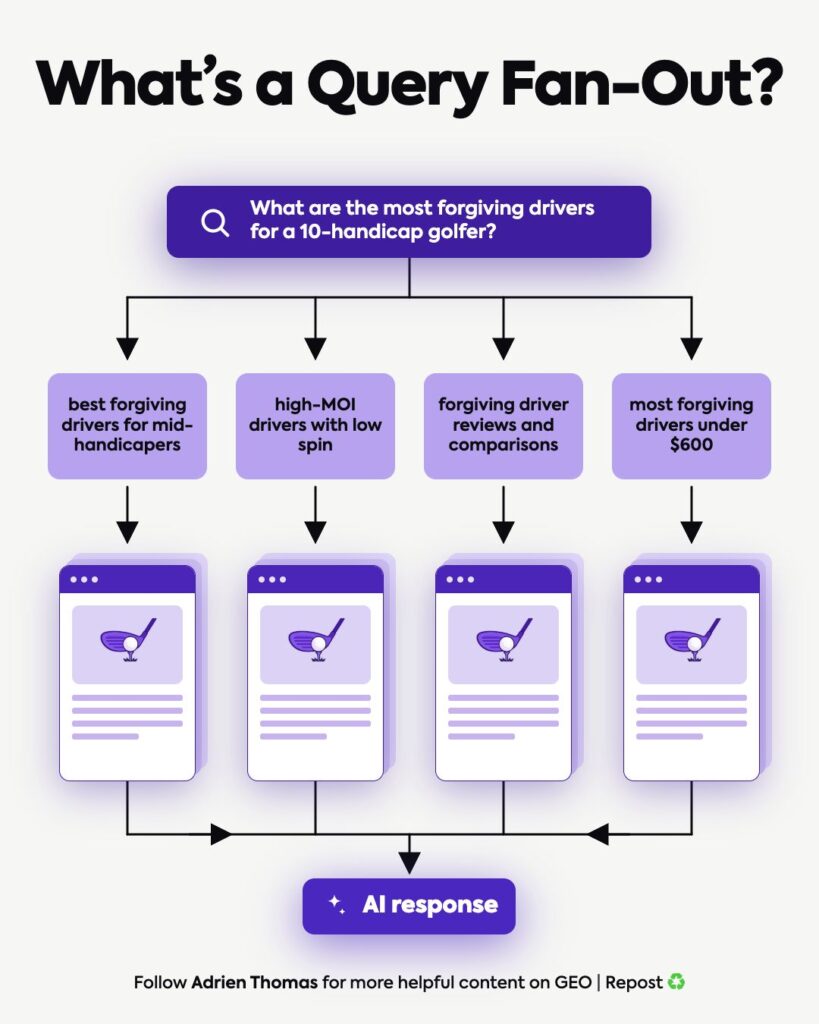
When this research feeds an agency brief, our guide to what an AEO agency does helps distinguish question research, content implementation and reporting responsibilities.
Query fan-out map: one buyer question, five searches
Illustrative example, not a record of actual AI-generated queries: a purchasing manager asks, “Which commercial refrigeration maintenance provider should we hire for three locations?” A retrieval system may break that decision into separate information needs. Use the map below to structure useful content, not to predict exact Google or ChatGPT queries.
| Possible sub-question | Useful evidence | Best destination |
|---|---|---|
| Service coverage and response times | Actual areas, hours, scope and exclusions | Service-area page |
| Preventive maintenance vs emergency calls | Comparison of inclusions and trade-offs | Comparison guide |
| Pricing and hidden extras | Quote factors and clear cost assumptions | Pricing FAQ |
| Industry expertise | Verifiable qualifications, references and cases | Credentials or case-study page |
| Supplier selection | Practical, independent decision checklist | Buying guide |
Diagram: Buyer question → information needs → page inventory → evidence gaps → content improvements → relevant internal links → repeatable monitoring. There is no benefit in creating five near-duplicate URLs just to match hypothetical subqueries.
See our 90-day SEO content plan and competitor content analysis guide for research workflows.
How the query fan-out technique works
Recognizing query expansion is useful when assessing AI Overviews optimization for more complex searches.
- Interpret the request: identify the information needed to answer the question.
- Explore related questions: generate searches that address relevant aspects of the request.
- Retrieve information: find sources that may help answer those aspects.
- Compose the response: use selected information to produce an answer, potentially with source links.
This is a simplified explanation, not a universal specification for every AI assistant. Search behaviour varies by platform, mode and question. A chatbot does not necessarily search the web for every answer, and there is no fixed number of fan-out searches that applies to all prompts.
How do you cover every sub-question an AI will ask? One customer question can become a full cluster of content, as this short shows.
A query fan-out example
Consider the question: “How do I choose an SEO agency for a service business in Singapore?” The following is an illustrative content-planning map, not a captured search trace from an AI platform.
| Related question | Useful answer | Where it belongs |
|---|---|---|
| What services should the agency include? | Scope, responsibilities and implementation examples. | The main service guide. |
| How do I compare agency proposals? | A checklist covering deliverables, ownership and reporting. | A section in the guide, or a detailed resource if needed. |
| How does SEO connect to AI visibility? | An explanation of the work and its limitations. | A supporting SEO/GEO section. |
| How long will results take? | Milestones, dependencies and a measurement framework. | A linked timeline resource. |
Our Singapore SEO services guide shows how these buying questions can be addressed together. A question requiring a different decision or deeper treatment can have its own page, connected with a descriptive internal link.
Query fan-out, long-tail keywords and grounding
A long-tail keyword is a relatively specific search expression. Query fan-out describes a process that can generate several searches from a request. The resulting queries may be long or short.
Grounding means connecting an answer to external information. Fan-out can help retrieve that information, but the two terms are not interchangeable. Seeing a cited source tells you something about the answer’s evidence; it does not necessarily reveal every search that occurred.
If you are researching “grounding queries fan out”, distinguish three things: the user’s original question, any observed or proposed retrieval queries, and the sources actually cited. Mixing them produces misleading analysis.

How to use fan-out analysis in a content strategy
1. Start from a real buyer decision
Use customer conversations, Search Console queries and your service priorities to identify useful questions. Keep speculative prompts separate from evidence of actual demand.
2. Label the evidence
Mark whether related queries were observed in a supported tool, generated as suggestions, or inferred from the response. A simulated query list is useful for brainstorming but should not be reported as the platform’s actual search history.
3. Map questions to existing pages
Decide whether each question belongs in the main page, an FAQ or a separate resource. Review the pages you already have before creating more. Remove duplication where multiple pages answer the same question without adding anything distinct.
4. Add useful evidence and internal links
Use examples, explicit service details and relevant first-hand knowledge. Connect supporting resources to their main content hubs. Check for orphan pages that readers cannot reach through useful navigation.
5. Review the outcome consistently
Track the priority questions and the pages edited. Compare recurring answer samples and relevant search performance, while recognising that other changes can influence results. Our guide to GEO timelines and measurement explains how to structure that review.
How to evaluate a query fan-out tool
Ask what the tool observes and which platforms it supports. Does it show actual exposed searches, simulate likely queries or infer topics from citations? Can you export timestamps, prompts, source URLs and the conditions of each run?
At Crescendo, we use Clairon in our AI visibility workflow. When reviewing fan-out data, distinguish observed information from inferred opportunities and check the coverage of the platform and mode being tested.
No tool output should be treated as a complete view of every platform’s internal retrieval process without evidence.

What query fan-out does not mean
- It does not mean every response uses exactly eight searches.
- It does not mean every related question needs a separate article.
- It does not guarantee that an indexed page will be cited.
- It does not replace service expertise, technical SEO or useful original information.
For the underlying mechanism and eligibility requirements, see Google’s documentation on AI features and websites.
Turn a fan-out map into a content brief
A query fan-out exercise is useful only when the resulting questions map to actual decisions or existing pages. Avoid treating every related question as a reason to publish a separate article.
- Write one high-intent buying question and identify its likely constraints, alternatives and verification needs.
- Group subquestions by intent: eligibility, comparison, pricing, evidence and implementation.
- Assign each group to an existing service or guide URL before proposing a new page.
- Add a short answer where it helps the reader, linking to a detailed page only when necessary.
- Review search and enquiry data after publication; a simulated fan-out is not measured search volume.
See internal-link discovery checks and our 90-day content planning framework.
Applying the method to local services
A buyer comparing GEO services in Bangkok may need different language and service-coverage information from someone selecting a GEO provider for Dubai. Local examples should answer those differences, rather than swap city names in otherwise identical pages.
Want a more in-depth explanation on what a query fan-out is? Check out our video below:
Frequently asked questions
Can Search Console show all fan-out queries?
No. Use its query and page data as search-performance evidence, not as a complete trace of an AI assistant’s internal retrieval process.
Should I answer every question on one page?
Group questions that help the same reader complete the same task. Create a separate resource when a topic needs a distinct, useful treatment. Page length alone does not decide the right structure.
Can fan-out analysis improve citations?
It can identify information gaps worth addressing. Whether a platform subsequently cites the page must be measured; it cannot be promised from a query map alone.
Need help turning buyer questions into a content plan? Start with an AI visibility audit to review your current sources, pages and priorities.