
A content audit is a series of decisions about usefulness and business value—not a spreadsheet of red and green cells.
CRESCENDO / PRACTICAL SEO FRAMEWORK
The four decisions in a content audit
An evidence-led decision model, not a guaranteed ranking formula.
1
KEEP
Protect pages that work
2
REFRESH
Improve useful but weak pages
3
MERGE
Consolidate overlapping intent
4
REMOVE / NOINDEX
Retire only with evidence
When a website’s organic traffic stalls, the instinct is often to publish more. Yet an overlooked issue is frequently hiding in existing content: strong pages are no longer linked internally, a useful article answers yesterday’s version of a question, or two near-identical posts divide attention without serving distinct intent.
A content audit should separate genuine problems from ordinary data noise. It should also resist the fashionable idea that deleting pages automatically improves rankings.
Establish the measurement window before grading pages
Export the indexable URL inventory, content type, publication and review dates, canonical targets and internal-link counts. Join Search Console query/page metrics with analytics and CRM measures where possible. Compare equivalent time periods and segments. Seasonal topics need year-over-year context; very new pages need time to be discovered.
Useful fields include impressions, qualified clicks, average position, assisted leads, page purpose, search intent, backlinks, topical accuracy, unique evidence, and the existence of a better page already on your site.
The four primary decisions
Keep: the page does a clear job
Keep an article if it serves a distinct audience question, is accurate, receives relevant engagement or meaningfully supports a commercial topic. Low traffic alone is not a deletion criterion. Some essential compliance, customer support or product documentation pages have modest search demand by nature.
Refresh: the topic is right, the answer needs improvement
Refresh when intent still fits but sources, screenshots, product comparisons, structure or user examples are outdated. Change content because it genuinely needs to change, not to display a fresher date. Capture before-and-after rankings, engagement and leads but be cautious about attributing all gains to the edit.
Merge: two pages answer the same question
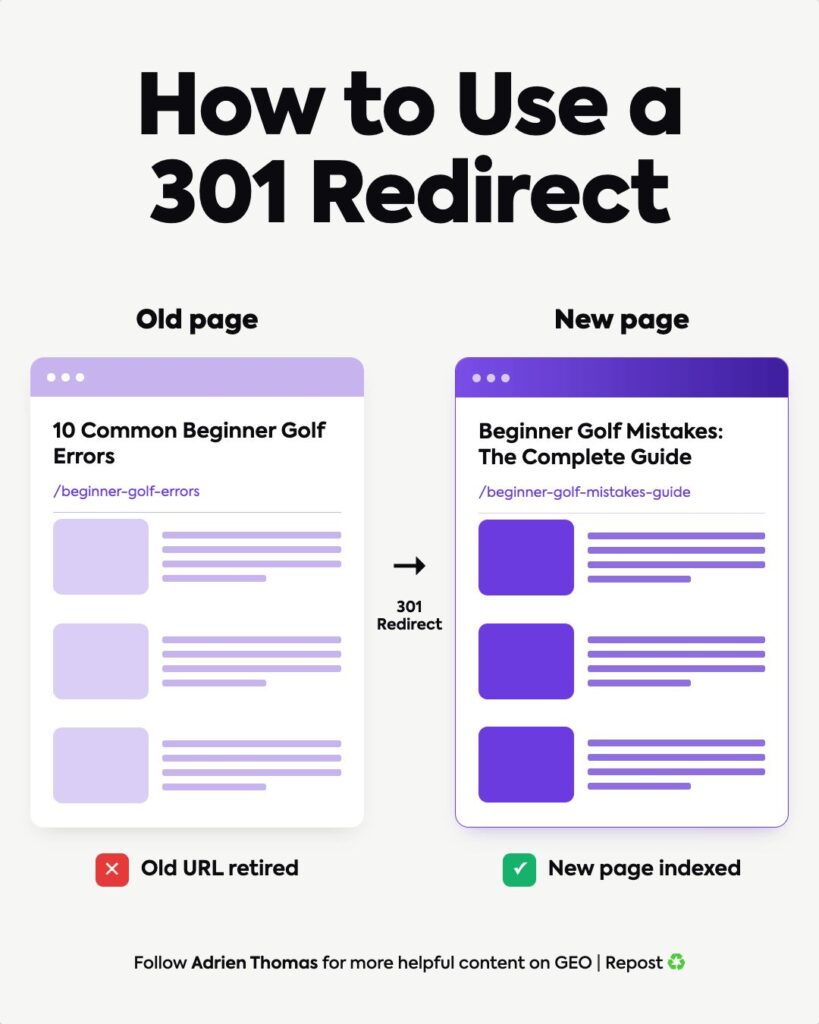
Compare their query overlap, distinct sections, conversion behavior and backlinks. If one consolidated resource better answers the intent, migrate the useful material and permanently redirect the retired URL to a genuinely relevant destination. Do not redirect every obsolete article to the homepage.
Delete or noindex: the page no longer earns its place in search
Remove information that is obsolete and cannot be responsibly maintained, or prevent indexation for utility pages that are not intended to be search landings. Choose the correct technical action for each situation; noindex, a 404/410 and a 301 do different jobs. Preserve meaningful user journeys and link destinations.
A real Crescendo Search Console diagnostic
During an internal US Search Console sample covering October 24–26, 2026, one newly published Crescendo guide recorded 384 impressions, zero clicks and an average position of approximately 83.5. It would be misleading to treat that as proof of a bad title: a page appearing this low in the results has a discoverability and ranking challenge first. This is a three-day snapshot, not a performance trend or a controlled test.
The same limited sample showed two related Crescendo pages receiving impressions for the query “geo services for accountants.” The total was only seven impressions across those pages. That is a prompt to review intent overlap—not sufficient evidence, on its own, to declare harmful keyword cannibalization.
Why this matters: first-party evidence is valuable only when its scale and limitations are stated. A dashboard alert is a question, not a conclusion.
Our editorial decision matrix
Score each URL for relevance to buyer intent, information freshness, evidence quality and commercial usefulness. Then inspect overlap and technical constraints. A page can rank poorly but be worth keeping; a high-traffic page can attract the wrong audience; a weak page can become strong when added to the right content hub.
| Situation | First editorial choice | What to verify |
|---|---|---|
| Accurate, distinct, commercially useful | Keep | Navigation and internal links |
| Useful topic, outdated examples | Refresh | Source freshness and intent fit |
| Two pages satisfy the same intent | Consider merge | Queries, backlinks, unique sections |
| Unrecoverably obsolete and no useful successor | Consider removal | Link destinations and user impact |
The Crescendo Take: avoid the red-traffic trap
A common audit shortcut marks every URL with low clicks as “underperforming.” We reject that rule. A page should be judged by the job it was created to perform and the evidence that it can still perform it. At Crescendo, our October 2026 WordPress review found 90 published posts; the size of the inventory made structured triage worthwhile, but page count alone said nothing about quality.
FAQ
Does deleting low-traffic content improve SEO?
There is no universal benefit. Remove or consolidate only when the user experience, duplication or content quality warrants it, and choose the right technical treatment.
How do I identify cannibalization?
Look for sustained query overlap between pages serving effectively the same search intent, not a handful of shared impressions or a single fluctuating position.
How often should a content audit happen?
Review business-critical pages continuously, with a more systematic inventory review once or twice per year depending on the pace of change.
Next step
Read our guides to keyword cannibalization and orphan pages, or ask Crescendo to help plan a content audit with defensible decisions.