
TL;DR
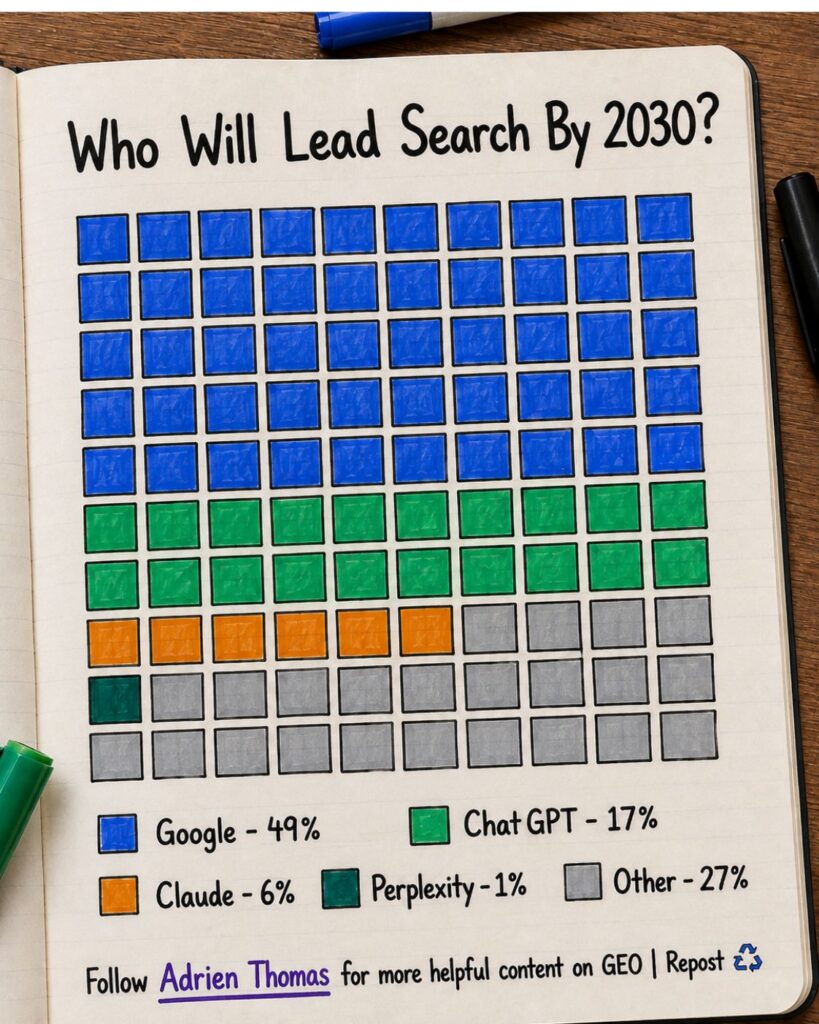
- NP Digital asked 1,000 people in August 2026 which AI platform will shape search the most by 2030: Google 49%, ChatGPT 17%, Claude 6%, Perplexity 1%, Other 27%.
- ChatGPT changed how people search 3 years ago: full questions and direct answers, instead of a list of links.
- Google built that same behavior into its own product. AI Overviews and AI Mode now show up on top of about 16 billion searches a day.
- None of this means SEO is dead. Organic search traffic barely moved last year, and Google’s query volume hasn’t dropped.
- Whichever platform leads by 2030, your buyers already deal with both today: regular search results and an AI-written answer on top. You need SEO and GEO to cover both.
Most people still expect Google to run search in 2030, even though ChatGPT is the platform that changed how people search in the first place. Both things are true at once.
ChatGPT taught millions of people to type full questions instead of a few keywords. Google built that same habit into its own results page, without losing its user base.
None of this makes SEO dead.
What changed is what shows up first: an AI-written answer at the top of the page, on Google and everywhere else, that a growing number of people read before they click anything. Your visibility plan needs to cover that AI answer and the regular search results sitting right below it.
What the NP Digital Survey Found
NP Digital asked 1,000 people in August 2026 which AI platform will have the biggest impact on search by 2030. The results:
- Google: 49%
- ChatGPT: 17%
- Claude: 6%
- Perplexity: 1%
- Other: 27%
Two things stand out here.
First, 1 in 2 people expect Google to lead, 3 years after ChatGPT first shook up how people search.
Second, “Other” scored 27%, higher than ChatGPT. A quarter of the people surveyed either expect a platform that hasn’t shown up yet, or just don’t have a strong opinion. For a market this young, that much uncertainty makes sense.
I agree with the direction of this survey.
ChatGPT Changed How People Search 3 Years Ago
ChatGPT probably had the biggest impact on search of the past 10 years.
It introduced millions of people to a more conversational way of searching: full questions instead of keywords, and one direct answer instead of a list of links.
That shift now shows up inside Google’s own numbers. Google’s AI Mode usage report, published in May 2026, found the average AI Mode query is 3 times longer than a typical search query. People learned to type full questions to a chatbot, and they brought that habit back to the search bar.
Google Already Built This Into Search
Google still handles about 16 billion queries a day. But a Google results page now shows 2 things: the regular list of links, and an AI answer above it, either an AI Overview or the fuller AI Mode experience.
That AI answer keeps showing up more often:
| AI feature | How common it is | How fast it grew |
| AI Overviews | Appear on almost 50% of Google searches | Similarweb tracked the jump from 15% to 43% in a single year |
| AI Mode | Passed 1 billion monthly users, per Google at I/O 2026 | Grew 121% in about a year, with query volume doubling every quarter |
Both sit right at the top of the page. Google took the habit ChatGPT introduced and made it the default for billions of people who never had to open a new app.
Meanwhile, ChatGPT’s share of the market is sliding, even though the number of people using it hasn’t dropped. Similarweb data shows ChatGPT’s share of AI chatbot traffic fell from 87.2% to 68% in the 12 months to January 2026, then kept sliding to about 54% by May. If that keeps up, it drops below 50% this year.
One more Similarweb number explains why Google absorbed the shift so easily: 95% of ChatGPT users still use Google too. For most people, AI search became one more tool next to a habit they already had.
“I agree with the direction of this survey. ChatGPT changed how people search, and Google built that behavior into its own product without losing its scale. So yes, I can see Google still leading search in 2030.”
Adrien Thomas, co-founder of Crescendo
The 2030 Prediction Matters Less Than How People Search Right Now
The survey asks about 2030, but your pipeline depends on how buyers search today, and today’s search already runs through an AI answer on every major platform.
A prospect researching your category in 2026 might start with a question in ChatGPT, refine it in AI Mode, scan an AI Overview, and click through to 2 or 3 websites at the end, if they click at all. Similarweb found that the share of Google searches ending without any click rose from 56% to 69% after AI Overviews rolled out.
None of that changes based on who leads in 2030. The AI answer shows up first today, on Google and everywhere else, and more people get their answer without clicking anything.
Is SEO Dead? Here’s What the Data Shows

Google’s 16 billion daily queries didn’t go anywhere, and neither did organic search traffic.
Graphite’s analysis of Similarweb data across the 40,000 biggest US websites, reported by Search Engine Land in January 2026, found organic search traffic down only 2.5% year over year. That’s nowhere near the 25% to 60% drops some people in the industry keep repeating.
Search “SEO vs GEO” today and you’ll find most articles land on the same point we keep making at Crescendo: you need both.
- SEO gets you found, understood, and ranked by search engines.
- GEO gets your brand and content picked up inside AI-generated answers.
So what is GEO exactly? Short for generative engine optimization, it’s the work of showing up inside the AI answer itself, on ChatGPT, Gemini, AI Overviews, and AI Mode, instead of just in the list of links below it.
The stakes are already commercial. Semrush found in July 2026 that 92% of B2B software buyers said AI influenced their vendor shortlist.
If your business depends on search for leads and revenue, you need both: SEO to stay visible in the results that still carry most of the volume, and GEO to stay present in the AI answer that a growing number of people read first.
At Crescendo, we build for both, because our clients’ buyers already move through both.
FAQ
Is SEO dead?
No. Google still handles around 16 billion queries a day, and a Graphite analysis of Similarweb data found organic search traffic down only 2.5% year over year. The queries are still there. What changed is what shows up above them: an AI-written answer most people see first.
What is GEO?
GEO, short for generative engine optimization, is the work of getting your brand and content picked up inside AI-generated answers, on platforms like ChatGPT, Gemini, AI Overviews, and AI Mode.
Is SEO vs GEO really a choice you have to make?
No, and treating it as one is a mistake. SEO gets you found and ranked in regular search results. GEO gets you picked up inside the AI answer sitting above those results. Buyers move through both, so covering only one leaves the other wide open for competitors.
Who does the NP Digital survey say will lead search by 2030?
49% of the 1,000 people surveyed in August 2026 expect Google to lead by 2030. ChatGPT came second at 17%, then Claude at 6% and Perplexity at 1%.
Does AI search actually influence buying decisions?
Yes. Semrush found in July 2026 that 92% of B2B software buyers said AI influenced their vendor shortlist. AI answers are now part of how people decide who to buy from, especially in B2B.