
TL;DR
- E-E-A-T stands for Experience, Expertise, Authority, and Trust. It’s the framework Google’s human reviewers use to judge content quality.
- It isn’t a single ranking factor you can check off; Google uses a mix of signals to spot content that shows these qualities.
- 74.2% of new web pages now contain AI-generated content. That’s why E-E-A-T SEO signals are becoming the proof that sets your content apart.
- Semrush found pages with stronger E-E-A-T signals have a 30.64% higher association with AI citations. It’s a correlation, not proof of cause, but it’s a meaningful number.
- The practical move: build experience, expertise, authority, and trust signals in more places than just your own website.
E-E-A-T SEO comes down to one question: can you prove what you’re saying is true? E-E-A-T stands for Experience, Expertise, Authority, and Trust, Google’s framework for the qualities that make content worth trusting.
It was built for Google Search. But now that anyone can publish a decent article with AI, these same signals have become the proof that’s hard to fake, and early data suggests AI search engines reward them too when they decide which sources to cite.
What Is E-E-A-T?
E-E-A-T stands for Experience, Expertise, Authority, and Trust.
It comes from Google’s Search Quality Rater Guidelines, the document human raters use to judge whether search results are surfacing quality content. Semrush notes that Google added the second “E,” for Experience, in December 2022. Before that, the framework was just E-A-T.
One important point: there’s no E-E-A-T score sitting inside Google’s algorithm. Google’s own documentation says it directly: E-E-A-T itself isn’t a ranking factor, but Google uses a mix of signals to identify content that demonstrates these qualities.
Google actually treats Trust as the most important part of E-E-A-T. Its guidelines call it “the most important member of the E-E-A-T family.” Content can show experience, expertise, and authority, but if it isn’t trustworthy, none of that saves it.
SEO.ai points out that Google’s Quality Rater Guidelines run 176 pages of real detail for raters to work from.
One more nuance: Google gives extra weight to E-E-A-T-aligned content on topics that affect people’s health, finances, or safety, the YMYL (Your Money or Your Life) categories. If you operate in one of those, this framework matters even more.
So there’s no score to chase. The work is building the qualities these signals are designed to detect.
Why It’s Harder to Fake Than It Looks
Anyone can publish a decent article today with AI.
That’s not an exaggeration. Ahrefs analyzed 900,000 new English-language web pages in April 2025 and found that 74.2% contained AI-generated content.
3 out of 4 new pages. A decent article is now a commodity.
That changes what competition looks like. When everyone can produce 2,000 competent words on any topic in minutes, what separates you is the proof behind those words.
And that’s exactly what E-E-A-T describes: proof.
- Proof you actually tested the product.
- Proof a real, credentialed person wrote or reviewed the content.
- Proof other people in your space reference your work.
- Proof readers can verify what you’re claiming.
AI can’t generate any of that just because you ask it to write 2,000 words. That’s the point.
What E-E-A-T SEO Looks Like in Practice
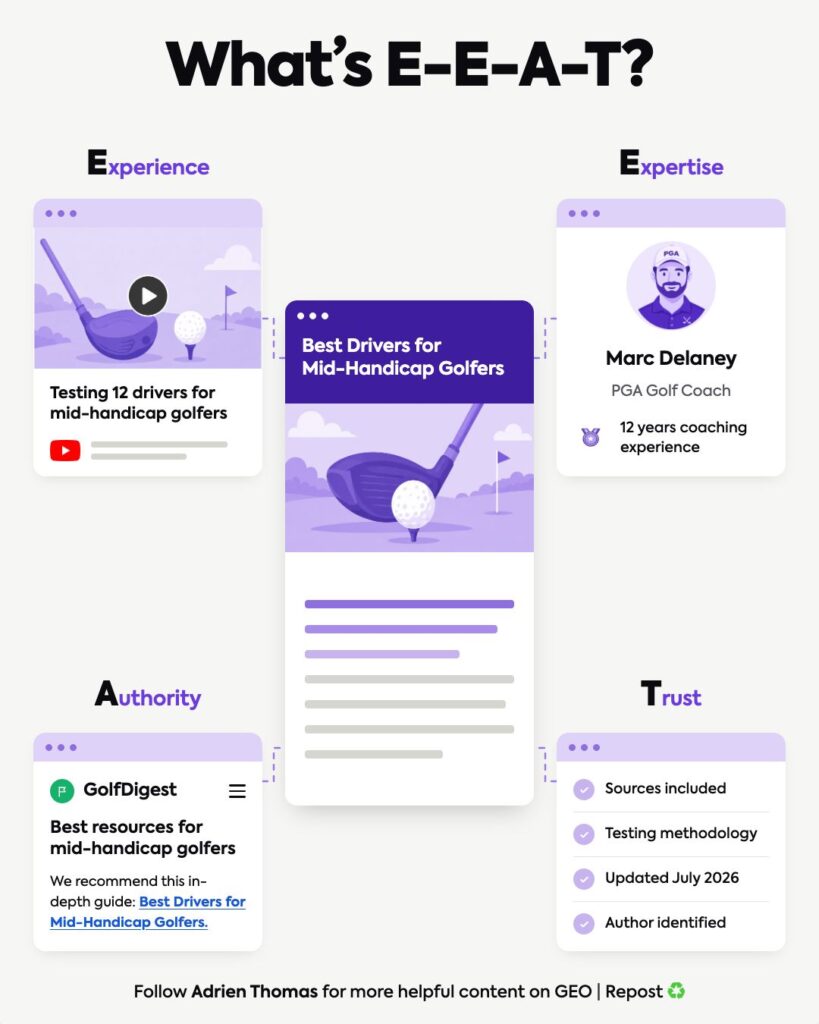
Take a concrete example: an article titled “Best Drivers for Mid-Handicap Golfers.”
| What It Means | What It Looks Like Here | |
| Experience | First-hand proof you actually did the thing | A YouTube video of you testing 12 different drivers on the course, with original photos, test data, and personal observations |
| Expertise | Real knowledge and credentials behind the content | The article written or reviewed by a PGA Golf Coach with 12 years of coaching experience, named and credited |
| Authority | Built outside your own website, from what other people say about you | A recognized golf website links to your guide, and other publications and people reference your work |
| Trust | Content readers can verify and rely on | Sources included, testing method explained, content kept up to date, author clearly identified |
For Experience, no one can copy that testing video by prompting an AI. The article that links to real footage carries something the competing articles don’t.
For Expertise, that knowledge has to come from you, since an AI model doesn’t have it.
For Authority, Search Engine Journal points to a few sites doing this well outside golf. Dogster.com uses veterinarians and certified trainers as authors, GadgetMates runs a physical repair shop and writes from hands-on repair work, and Homesteading Family is written by people who live self-sufficiently on a 40-acre property in Idaho. In each case, the credential or the lived experience is something a reader can actually verify.
For Trust, this is the element Google considers the most important of the 4, and it’s also the most mechanical to get right. Most of it comes down to being upfront about your sources and who’s behind the content.
How to Build E-E-A-T SEO
Each letter maps to concrete actions.
For Experience:
- Record videos of your actual testing, implementation, or process. YouTube is the natural home for this.
- Publish original photos, data, and observations from your own work.
- Document specifics AI can’t invent: dates, numbers, what went wrong, what surprised you.
For Expertise:
- Put named authors with real credentials on your content.
- Have subject-matter experts write or review articles, and say so on the page.
- Surface expert judgment in the content itself: lived examples and judgment calls a generalist wouldn’t make.
For Authority:
- Build third-party mentions across relevant websites, LinkedIn, Reddit, and industry publications.
- Earn links and references from recognized sites in your space.
- Show up where your market already looks. Semrush’s 3-month study of AI citations found Reddit and LinkedIn among the top 5 most-cited domains on ChatGPT, Google’s AI Mode, and Perplexity. If your brand shows up on those surfaces, AI engines have more material to draw from, and that’s a big part of how to get cited by AI in the first place.
For Trust:
- Cite your sources. Explain your methodology.
- Keep content up to date, and show the date.
- Identify the author clearly. Make it easy to check who’s behind the claims.
“For GEO, this framework gets even more interesting. E-E-A-T pushes your brand and content across multiple surfaces: YouTube, LinkedIn, Reddit, third-party publications, and your own site. That kind of footprint is much harder to copy than another generic article covering the same keywords and intent as everyone else.”
Adrien Thomas, co-founder of Crescendo
What the Data Says About E-E-A-T and AI Citations

There’s now data on whether these signals matter beyond Google.
Semrush analyzed 337,785 URLs, including 304,805 URLs cited by LLMs across ChatGPT Search, Google AI Mode, and Perplexity. It scored cited and non-cited pages across 13 content parameters and measured the difference.
Pages with stronger E-E-A-T signals showed a 30.64% higher association with AI citations.
For context: E-E-A-T was the second strongest signal of the 13 tested, behind clarity and summarization (32.83%) and ahead of Q&A formatting (25.45%).
The important caveat, and Semrush is careful about this too: it’s a correlation, and correlation isn’t the same as causation here. Pages with strong E-E-A-T signals tend to be well-made pages overall, so separating cause from correlation isn’t possible with this data.
Search Engine Land’s review of nearly 8,000 AI citations across ChatGPT, Gemini, and Perplexity found something that points the same way. 82.5% of citations went to a deep, specific page rather than a homepage. And pages that already ranked for a related “fan-out” question were 161% more likely to get cited than pages ranking for the main keyword alone.
Depth and proof beat generic coverage again.
At Crescendo, this matches what we see in client work: the content that earns AI citations tends to be the content with real proof behind it. Keyword coverage alone rarely gets a page cited.
The 4 Questions to Ask Before Publishing
E-E-A-T shouldn’t become another SEO checklist. The point is to give people, Google, and AI engines real reasons to trust what you publish.
So before your next article goes live, check 4 things:
- What first-hand experience are we bringing?
- Who has the expertise to write or review it?
- What external signals support our authority on the topic?
- What makes the information easy to trust and verify?
If the answer to all 4 is “nothing,” the article will read fine and do nothing. It joins the 74.2%.
If you can answer even 2 of them with something real, you’re publishing content most of your competitors can’t reproduce. And if you want to see whether that proof actually translates into AI visibility, track which of your pages get cited and which answers mention your brand across AI platforms. That’s what we built Clairon for.
FAQ
What does E-E-A-T stand for?
Experience, Expertise, Authority, and Trust. It’s a framework from Google’s Search Quality Rater Guidelines used to judge content quality.
Is E-E-A-T a Google ranking factor?
No. Google’s own documentation states that E-E-A-T itself isn’t a specific ranking factor, but that Google uses a mix of signals to identify content that demonstrates these qualities.
Which part of E-E-A-T is most important?
Trust. Google’s documentation names trust as the most important of the 4 elements. Without it, experience, expertise, and authority won’t save the page.
Can AI-generated content have strong E-E-A-T?
An AI can draft the words, but it can’t supply the proof. Experience, credentials, third-party authority, and a verifiable method all have to come from you. That’s why E-E-A-T SEO separates content in a market where 74.2% of new pages contain AI-generated text.
How do you know if E-E-A-T SEO is helping you get cited by AI?
Track citations and mentions of your pages and brand across AI platforms, broken down by prompt. Semrush found a 30.64% higher association between strong E-E-A-T signals and AI citations across ChatGPT Search, Google AI Mode, and Perplexity, and tools like Clairon show which content AI engines are pulling from and where your brand shows up in the answers.