
If you’re looking up how to rank in ChatGPT, your mental model is already working against you. There’s no position 1. There’s no page of ten blue links. When someone asks ChatGPT to compare tools, pick a supplier, or explain a category, the model either retrieves your brand from sources it can reach and decides to name you – or it doesn’t.
ChatGPT SEO is the work of making that retrieval, and that citation, more likely. It sits inside the broader discipline covered in our LLM SEO guide, but the mechanics are specific enough to deserve their own playbook. Here’s the honest version: three ways your brand can appear, and the levers that move each one.
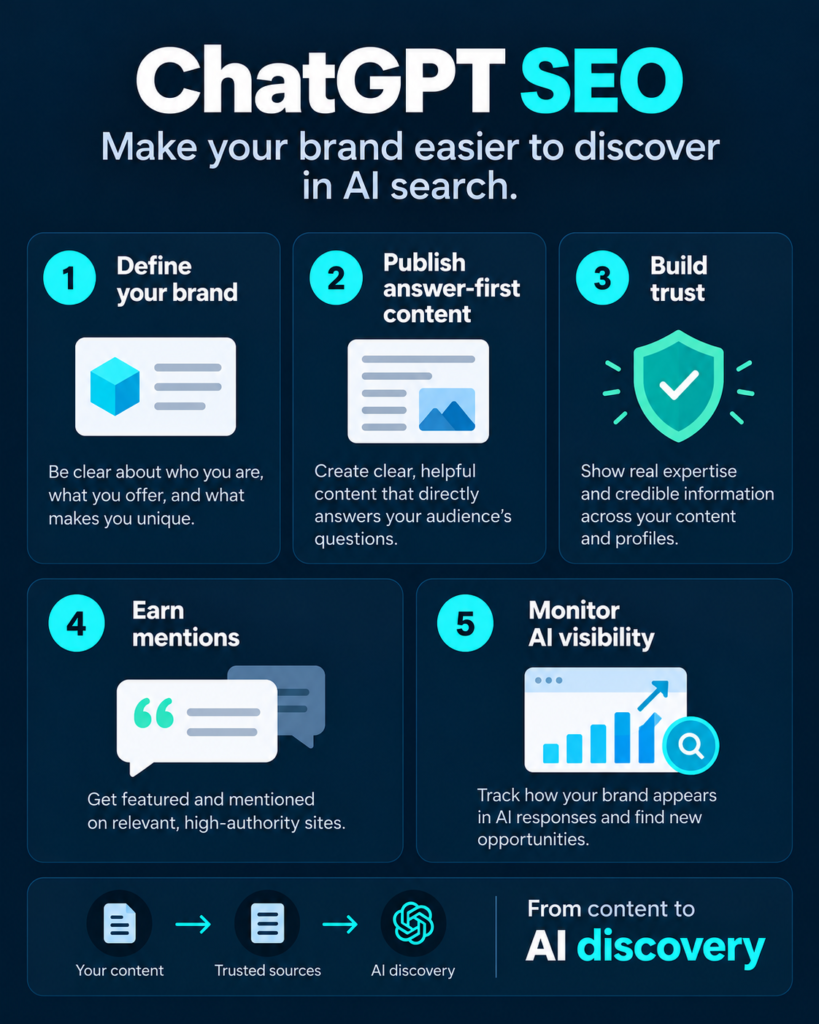
Key takeaways
- ChatGPT doesn’t rank brands – it retrieves and cites them. You compete for a mention inside a generated answer, not a position on a results page.
- There are three distinct surfaces: training data (fixed, slow), live search retrieval (fast, index-driven) and user-triggered browsing (per-session). Most guides blur them together; they need different tactics.
- Third-party sources carry most of the weight for “best X” prompts – Reddit, review sites, comparison articles and Wikipedia more than your own homepage.
- The fastest levers are entity clarity, structured data, comparison content and crawler access – not another 2,000-word blog post.
- Measurement replaces rank tracking: fixed prompt sets, mention rate, citation share, and referral traffic from chatgpt.com.
What “ChatGPT SEO” Actually Means
The phrase is a useful shorthand and a slightly misleading one. What you’re really doing is optimising for retrieval and citation inside a generative answer. SEO habits like keyword density and rank tracking don’t transfer cleanly, because the output isn’t a list.
ChatGPT has roughly 800 million weekly active users as of October 2025 – a figure Sam Altman announced at OpenAI’s Dev Day. That’s a discovery surface too large to ignore, and it behaves nothing like Google.
Why There Is No Ranking in ChatGPT
A search engine returns a ranked list. A language model writes a paragraph. Your brand either appears in that paragraph, with or without a link, or it doesn’t.
That changes the unit of competition. You’re not fighting for slot 3 versus slot 7. You’re competing to be one of two or three names the model is willing to stand behind in a specific conversation. A single answer can name your competitor twice and never mention you – and there’s no page 2 to recover on.
Two consequences follow:
- Answers vary run to run. Ask the same prompt tomorrow and the names shift. Visibility is a rate, not a position.
- Being cited and being recommended are different things. A 2026 analysis of 278 B2B SaaS responses found 66% of brand recommendations happened without a citation to the brand’s own site. The model may name you without ever quoting you.
The Three Ways Your Brand Appears
This is where most “ChatGPT for SEO” articles get vague. There are three separate routes, and they reward different work.
1. Training data (static). The model’s weights contain what it learned before its knowledge-cutoff date. If your brand is well-represented in that corpus, it can name you with no web lookup at all. This route is slow, largely retrospective, and controlled by GPTBot access. New brands are disadvantaged here by definition.
2. Live search retrieval (dynamic). Since ChatGPT Search launched on 31 October 2024, the model can fetch fresh web results mid-conversation. OpenAI has said it uses third-party search providers and that Bing is an important one. Here, current, crawlable, well-structured pages win, and links can appear in a Sources panel.
3. User-triggered browsing (per-session). When the user asks ChatGPT to open or read a specific page, the ChatGPT-User agent fetches that URL for the session. OpenAI notes that robots.txt rules may not apply to these user-initiated visits – so this route is about being findable and quotable when someone points the model at you, not about crawl permission.
Note what this means for strategy: content that fixes your training-data footprint won’t help you tomorrow, and content published today can’t retroactively enter the training corpus. Match the lever to the surface you’re actually targeting.
Prefer to watch? Our team walks through the actions that move the needle fastest.
How ChatGPT Decides What to Mention
No one outside OpenAI can read the ranking function, but the observable pattern is consistent: the model leans on sources it trusts for the specific question, then synthesises. Your job is to be in that trusted set.
Retrieval and the Sources It Pulls From
When ChatGPT answers a shopping or “which tool” prompt, it typically retrieves a handful of sources and blends them. A 2026 shopping study of 83 conversations found cited sources were split roughly 25% brand sites and 39% user-generated content for validation – a reminder that the model doesn’t only read marketing pages.
Practically, retrieval favours:
- Pages that state facts plainly and early, in extractable sentences.
- Sources that already rank well in the underlying search index (Bing, in ChatGPT’s case).
- Content that answers a comparison or decision query rather than describing your company.
- Recency where the query implies it – “best CRM 2026” beats a 2021 competitor.
Why Some Brands Get Named and Others Don’t
Three things separate the named from the invisible.
- Entity clarity. If the model can’t confidently resolve “Acme” to a single company with a defined category, it hedges or omits. Ambiguity gets dropped.
- Corroboration. A brand that appears across many independent sources reads as established. A brand that appears only on its own domain reads as promotional.
- Citable text. If your key claim lives in a hero image, a PDF or a video, it isn’t retrievable. Text that says the thing, in words, is.
The Role of Third-Party Sources (Reddit, Review Sites, Comparison Pages, Wikipedia)
For commercial prompts, third-party corroboration does more than your homepage – and OpenAI has been explicit about why it values one community source in particular. In May 2024, OpenAI struck a data-access partnership with Reddit, giving it access to current posts and comments via Reddit’s Data API. Reddit’s wider licensing arrangements were disclosed at a combined $203 million contract value that February.
That tells you where to put effort. Review platforms, “alternatives to X” listicles, G2 and Capterra profiles, industry round-ups, Wikipedia (where you meet notability rules) and genuinely useful Reddit threads are all citation surfaces for ChatGPT.
Building presence there is the practical core of getting cited by ChatGPT – and it’s the part that compounds. Review-based and community mentions are exactly what we help clients build and monitor through AI brand mentions tracking.
The Levers You Can Actually Pull
Six levers, ordered roughly by speed of impact for a business that is currently invisible.
1. Entity Clarity – Make It Unambiguous Who You Are
Define your brand as a single entity in one sentence, everywhere: name, category, and what you replace. “X is a [category] for [audience]” beats three clever taglines. Consistent naming, one canonical description, and a real About page with named people all help the model resolve you without guessing.
2. Structured Data and Machine-Readable Facts
Schema.org markup gives ChatGPT explicit, parseable relationships. Prioritise Organization, Product, FAQPage and BreadcrumbList. Pair markup with plain-text facts in the body – schema describes, it doesn’t substitute. If your pricing, specs or availability only exist in an image, fix that first.
3. Comparison and “Best X” Content
Decision queries are where mentions happen. Publish honest comparison pages – including “X vs Y” and “best [category] for [use case]” – that a model can lift numbers and trade-offs from. Don’t pretend your competitor is worse at everything; balanced pages get cited, puffery gets skipped.
For a broader look at how AI search surfaces brands, this Ahrefs walkthrough is a good companion.
4. Third-Party Corroboration
Get named in the sources ChatGPT already trusts in your category. That means review-platform presence, industry round-ups, expert commentary, and data-driven PR. A single authoritative mention in a widely cited listicle can outweigh a quarter of your own content output.
5. Community Presence
Be present where buyers and models both look. Answer real questions on Reddit, Quora and niche forums with genuine substance. This isn’t spam outreach; it’s publishing answers useful enough to be retrieved. Given OpenAI’s Reddit access, a well-received thread is a durable asset.
6. Crawler Access (robots.txt, GPTBot, llms.txt)
Technical housekeeping most brands get wrong. OpenAI separates its crawlers:
GPTBot– training. Blocking it opts you out of future model training.OAI-SearchBot– ChatGPT Search inclusion. Blocking it removes you from search answers.ChatGPT-User– user-initiated fetches. robots.txt may not apply.
User-agent: OAI-SearchBot Allow: / User-agent: GPTBot Disallow: / That block is the common choice: allow search visibility, opt out of training. Then check the index that feeds retrieval – if Bing can’t crawl you, search-augmented answers can’t cite you.
On llms.txt: publish one if you like, but calibrate expectations. Adoption sits around 5.9% of the top 10,000 sites, and a 2026 server-log study found 97% of llms.txt files received zero AI requests. It’s a low-cost signal, not a ranking lever. Our AEO agency team treats it as a nice-to-have, never a priority over robots.txt and content.

ChatGPT SEO vs. Traditional SEO
The tactics overlap more than the industry admits, but the scoreboard is completely different.
| Dimension | Traditional SEO | ChatGPT visibility |
|---|---|---|
| Unit of competition | A ranking position on a SERP | A mention or citation inside a generated answer |
| Key signal | Backlinks, on-page relevance, engagement | Entity clarity, third-party corroboration, crawlable text |
| Content format | Long-form page optimised for a query | Extractable facts, comparison tables, clear definitions |
| Measurement | Rank tracker, impressions, clicks | Fixed prompt sets, mention rate, citation share |
| Time to impact | Weeks to months | Days for retrieval; months or longer for training data |
Notice what’s not on the right-hand list: keyword density. The model is reading for meaning and corroboration, not counting terms.
How to Measure ChatGPT Visibility
You can’t track a ranking that doesn’t exist, so build a measurement layer instead. Three components do 90% of the work.
Prompt Set Design
Write a fixed set of 20–50 realistic prompts a buyer would actually type – discovery (“best X for small teams”), comparison (“X vs Y”), and consideration (“is X good for Z”). Lock the wording. Now you have a repeatable instrument.
Citation Share and Mention Rate
Run the set weekly and code each answer. Track:
- Mention rate – % of runs that name your brand.
- Citation share – % of runs that link to a source you own or control.
- Share of voice – your mentions ÷ all brand mentions in that category.
Keep the denominator explicit. “Appeared in 30% of answers” and “won 30% of category mentions” are different claims. Run each prompt several times – answers vary – and log the date and model mode.
Referral Traffic from chatgpt.com
Cross-check behaviour with analytics. ChatGPT drove 87.4% of AI referral traffic across 10 industries in a 2025 Conductor study, so it’s the channel worth segmenting first. Filter for chatgpt.com and openai.com referrers, and watch conversion separately: a 2025 study of 94 retailers put ChatGPT’s e-commerce conversion at 1.81% versus 1.39% for non-branded organic search. See our walkthrough on how to track AI traffic for the GA4 setup, or use Clairon to run prompt-tracking and citation share across ChatGPT, Claude, Gemini, Perplexity and AI Overviews in one place.
Use Case 1 – B2B SaaS Goes from Invisible to Named in 6 of 10 Buyer Prompts
An illustrative engagement, figures from our own repeated prompt runs.
A workflow-automation SaaS had strong Google rankings and zero mentions across a 10-prompt buyer set we built in January. Diagnosis: the brand’s own site described features obsessively, but no third-party source framed it as a category option. It was invisible to retrieval that leans on trusted lists.
What we changed, over eight weeks:
- Rewrote the homepage and one product page around a single category definition, in plain text.
- Shipped three comparison pages (“Tool A vs Tool B”, “best workflow automation for ops teams”) with balanced trade-offs and a real table.
- Earned 4 third-party placements – two review-platform profiles, one industry round-up, one expert quote in a niche newsletter.
- Fixed crawler access and confirmed Bing indexing across all templates.
Result: at the eight-week re-test, the brand was named in 6 of 10 buyer prompts, up from 0 of 10. Citation share (a link to a source we controlled) reached 3 of 10. None of those wins came from a new blog post – they came from entity clarity and corroboration.
Use Case 2 – E-commerce Brand Learns ChatGPT Recommends Its Competitor (and Why)
A diagnostic case, and the more instructive one.
A mid-market homeware brand asked us why ChatGPT “kept pushing the competition” on queries like “best espresso machine for a small kitchen”. Prompt runs confirmed it: across 20 runs, a rival was named 14 times; our client, twice.
The reason wasn’t ranking. It was data completeness. The rival’s product pages listed dimensions, materials, water-tank size, noise level and warranty as text; our client kept most of that in spec images and a downloadable PDF. When the model assembled a comparison, the rival was simply easier to quote.
Fixes were unglamorous: move specs into text, add Product schema with price and availability, publish a “how to choose” guide, and correct inconsistent product names across retailers (the model was resolving variants as separate products). Twelve weeks later, client mentions rose from 2 to 7 of 20 runs – and, tellingly, the rival stayed at 14. The lesson: you’re not fighting for a fixed slot. You’re fighting to be readable enough to be included. There was room for both brands, and the client had simply been illegible.
How Crescendo Improves ChatGPT Visibility
We run ChatGPT visibility as an engineering problem, not a content-volume one. A typical engagement:
- Diagnose. Build the prompt set, baseline mention rate and citation share, and separate training-data from retrieval gaps.
- Fix the entity. Canonical description, schema, on-page plain-text facts, crawler access.
- Build citation surfaces. Comparison pages, third-party placements, review-platform presence, community answers.
- Measure continuously. Prompt tracking across engines, plus referral and conversion reporting in analytics.
As a specialist GEO agency, our focus is the retrieval layer competitors skip – the difference between content that exists and content a model will actually quote.
Crescendo’s Take
We’ve watched “ChatGPT SEO” get sold as a bundle of magic tricks, and most of that budget is wasted. Here’s our honest position.
What moves the needle: entity clarity, third-party corroboration, crawler access, and content a model can extract. That’s it. It’s closer to digital PR and technical hygiene than to content marketing.
What we consider wasted budget: bulk-publishing “AI-optimised” articles nobody corroborates, buying
llms.txtas a standalone service, chasing “ChatGPT ranking” reports that can’t exist, and rewording existing pages to include the word “ChatGPT”. None of it changes what the model retrieves.What we’d do first with a $5,000 budget: spend $0 on new content. Fix
robots.txtand structured data, rewrite the homepage and top product page for entity clarity, build two comparison pages, and use the rest to earn three or four third-party mentions. Then baseline the prompt set so you can prove movement in 60 days. If the budget is tight, that order never changes.
FAQ
What is ChatGPT SEO? ChatGPT SEO is optimising your brand so it gets retrieved and cited in ChatGPT’s answers. It covers entity clarity, structured data, comparison content, third-party corroboration and crawler access – not keyword ranking.
Can you actually rank in ChatGPT? No. There’s no ranked list to occupy. You can only increase the rate at which your brand is mentioned or cited across a defined set of prompts. Track mention rate and citation share instead of positions.
How do I get cited by ChatGPT? Be retrievable and quotable: state facts in plain text, use schema, keep Bing-indexed pages clean, and earn mentions on sources ChatGPT already trusts – review sites, comparison listicles, Reddit and Wikipedia. Being named and being linked are separate wins; chase both.
Does llms.txt improve ChatGPT visibility? Not on current evidence. Adoption is roughly 5.9% of top sites and around 97% of llms.txt files logged zero AI requests in a 2026 study. Publish it as a low-cost extra, but prioritise robots.txt, structured data and content.
How long does ChatGPT SEO take? Retrieval wins can show within days to weeks once pages are crawlable and citable. Training-data visibility moves on model-release cycles, so expect months or longer – and treat it as a by-product, not a plan.
How do ChatGPT SEO optimization and traditional SEO differ? Traditional SEO competes for a SERP position using backlinks and on-page relevance. ChatGPT SEO optimization competes for a mention inside a generated answer, judged by entity clarity, corroboration and extractability – and measured with prompt sets rather than rank trackers.