
Key Takeaways
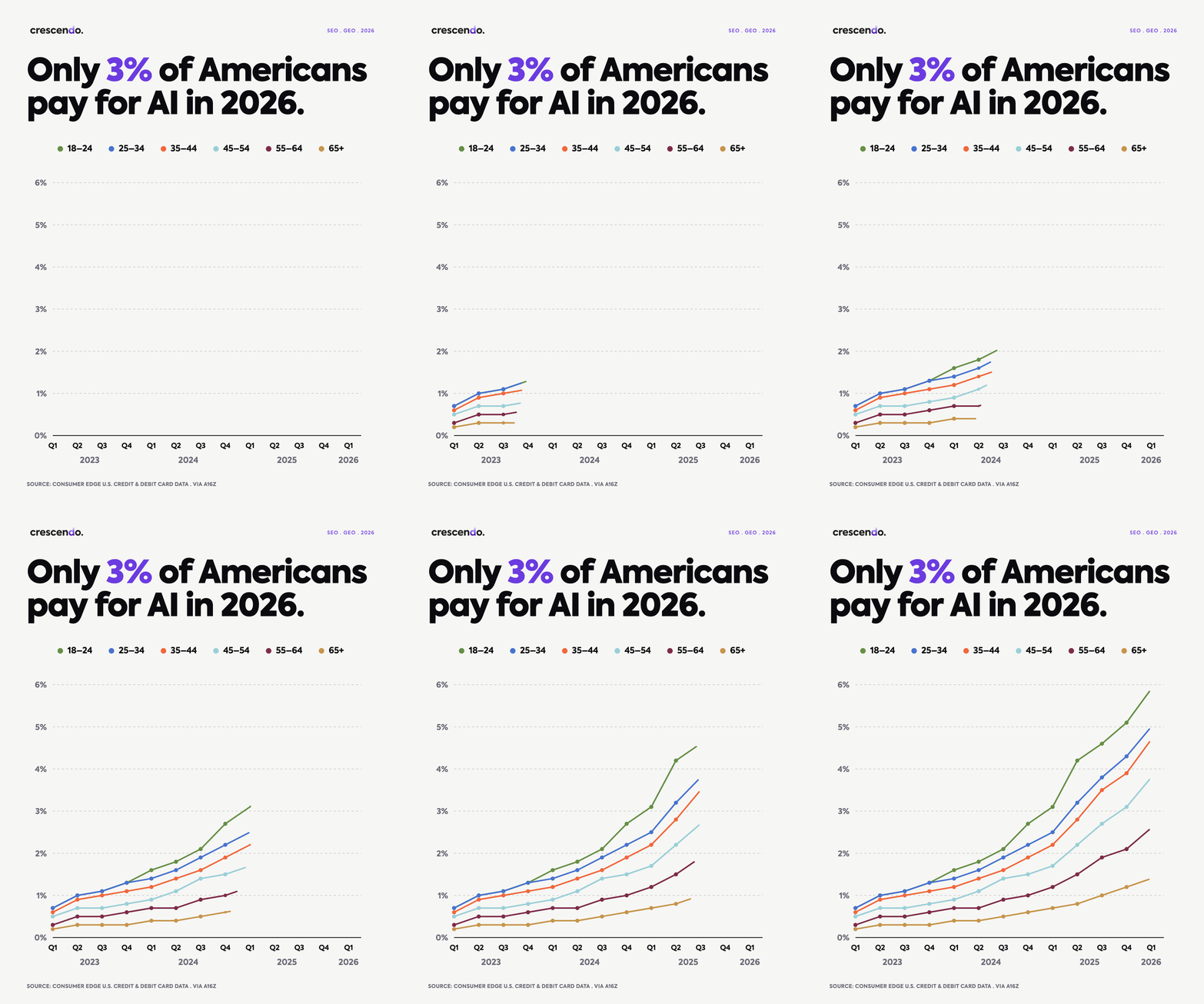
- Around 3% of U.S. shoppers paid for AI with their own card in Q1 2026, according to Consumer Edge data shared by a16z. That share roughly doubled in a year.
- Small businesses are slow too. Only about 17.7% of firms paid for AI by the end of 2025, according to JPMorganChase Institute, and the U.S. Census Bureau found no growth in AI use among firms with fewer than 20 employees.
- People who pay for AI use it daily at nearly twice the rate of those who don’t: 50% against 26%, per Menlo Ventures.
- If you run a small business, you still have time, and the best place to start is one task you already do every week.
AI for small business looks very different depending on where you get your information. On LinkedIn or YouTube, every company already seems to run on AI agents. In payment data, only a small minority of people and businesses pay for AI at all.
If you haven’t started yet, that gap works in your favor: you’re early. Paid adoption doubled in a year, though, so the head start won’t last, and the habit is worth building now.
Your Feed Shows You the Most Advanced Users
Spend 10 minutes on X, LinkedIn, or YouTube and it looks like every business owner already has a team of AI agents running on Hermes or Grok Bot. Every new model promises to multiply their revenue, and everyone seems further along than you.
Most of that content is built for clicks and engagement, which is fine. That’s how these platforms work. The side effect is a skewed picture: you see the most advanced users every day, and after a while they start to feel like the average.
How Many People Use AI, and How Many Pay for It
Menlo Ventures surveyed 5,067 U.S. adults in July 2026 and found that 64% use AI and 25% use it daily. Far fewer pay for it.
Consumer Edge tracks U.S. consumer credit and debit card transactions. Its data, shared by a16z, shows that in Q1 2026:
- Around 3% of U.S. shoppers purchased AI.
- Among people aged 18 to 24, it was around 6%.
This counts consumer payments only. Business and employer-paid spending is excluded, so someone using a ChatGPT or Claude seat paid for by their company doesn’t show up.
You’ll find much bigger numbers when you look up how many people pay for AI. Menlo Ventures reports that 55% of U.S. AI users pay for at least one AI product. That figure is self-reported, and it includes access someone else pays for, like an employer or a family member. The card data only counts people who pulled out their own card, so the 2 numbers answer different questions.
Between Q1 2025 and Q1 2026, the share of shoppers buying AI roughly doubled across age groups:
- 18 to 24: from around 3% to 6%
- 25 to 34: from around 2.5% to 5%
- 55 to 64: from around 1.2% to 2.6%
These are approximate readings from the chart. Spending moves the same way: Consumer Edge’s own tracking shows consumer AI spend growing by roughly 150% to 170% year over year for 5 consecutive quarters. The growth is fast, and the base is still tiny.
How Many Small Businesses Use AI?
The answer swings from under 1 in 5 to more than half, because each source measures something different.
| Source | What it measures | AI adoption figure |
|---|---|---|
| U.S. Chamber of Commerce, Empowering Small Business report (August 2025) | Small businesses that say they use generative AI | 58% in 2025, up from 40% in 2024 |
| U.S. Census Bureau, Business Trends and Outlook Survey (December 2025 to May 2026) | Businesses reporting AI use in their operations | 17% to 20% of U.S. businesses, and 37% of firms with 250 or more employees |
| JPMorganChase Institute (April 2026) | Firms paying for AI services, based on Chase Business Banking transactions | About 17.7% of firms by the end of 2025 |
It’s the same gap as with consumers: the Chamber counts what owners say, and JPMorganChase counts who actually pays. JPMorganChase notes that its method leaves out free tools, so real usage may be higher. It still shows how many businesses pay for AI, and that’s under 1 in 5.
Size widens the gap. In the JPMorganChase data, 26.1% of employer firms were paying for AI by December 2025, against 15.3% of businesses with no employees. The Census Bureau found AI use growing among firms with 20 or more employees between December 2025 and May 2026, while smaller firms stayed flat.
If you run a small business, chances are you’re in the group that hasn’t moved yet.
What Changes When You Pay for an AI Plan
Paying matters because it changes how people use AI. As Adrien puts it:
“If you’re not paying for a plan, you’re not really using AI yet. Most people I know on free plans use it as a chatbot: ‘What’s the best French restaurant in Bangkok?’ ‘What’s the best hotel for a family of four in Bali?’ That’s basically it.”
Adrien Thomas, co-founder of Crescendo
OpenAI’s own research points the same way. OpenAI’s economic research team and Harvard economist David Deming analyzed 1.5 million ChatGPT conversations in a National Bureau of Economic Research working paper. Between November 2022 and July 2025, non-work messages grew from 53% to more than 70% of usage. Practical guidance, seeking information, and writing make up nearly 80% of conversations.
The Menlo data shows how far payers pull ahead:
- They use AI daily at nearly twice the rate of non-payers: 50% against 26%.
- They’re 5 times more likely to use AI agents: 65% against 13%.
Usage limits explain part of the gap. Once you start building things and using AI throughout your workday, a free plan runs out quickly. OpenAI’s help center says free ChatGPT accounts get a limited number of messages on the flagship model every 5 hours, then switch to a smaller one. On Claude, the Pro plan gives at least 5 times more usage per session than the free plan, and Claude Code comes with the paid plans.
For a business, paying costs little. JPMorganChase says entry-level generative AI subscriptions are “typically priced at $20 to $30 per month,” and in 2025, 63% of the firms paying for AI sat in its lowest spending tier, $40 a month or less.
That’s why Adrien’s advice to business owners is blunt: “Just pay for the bloody plan and start using AI every day.”
Why Small Businesses Shouldn’t Wait
Some of your competitors have already moved, and they’re using AI to:
- Grow without hiring
- Get work done much faster
- Improve revenue and margins
- Launch new services and products sooner
The doubling in the payment data is the reason we wouldn’t wait. With around 3% of consumers and fewer than 1 in 5 small businesses paying for AI, you’re early. Wait 2 years, and the people who started this year will have 2 years of practice on you.
Start by changing how you work day to day. That’s what we’ve been doing at Crescendo for the past 8 months: rebuilding the agency around AI.
For a small business, this goes beyond keeping up. The Census data shows larger firms adding AI while the smallest ones stand still. For the businesses that keep waiting, we think it becomes a question of survival.
Where to Start With AI for Small Business: One Task You Already Do Every Week

ChatGPT, Gemini, Grok, Claude Code: pick one and start building something useful with it. Most of the new models your favorite influencer talks about can wait.
When you test AI for small business tasks, start with work you know well, because you can judge the result quickly. Pick one task you do every week, like a client report, a proposal, or research before a meeting.
- Give the AI the actual files and information.
- Add an example of what a good result looks like.
- Write out your instructions and constraints.
- Work with it until you have something you can use.
- The following week, run the same task with your improved instructions, and check how much time you saved, including the time spent correcting the output.
It’s a practical way to learn how to use AI at work, and a better starting point than another 45-minute tutorial about an agent you don’t have a use for yet.
Pick Your First Task This Week
Choose the task today, run it again next week with sharper instructions, and write down the time you saved. Repeating it every week is what turns AI into a regular part of your work.
We’ve spent the past 8 months rebuilding Crescendo around AI. If you want help working out where AI fits in your business, contact us at Crescendo.
FAQ
1. How many small businesses use AI?
It depends on how you measure it. The U.S. Census Bureau puts AI use at 17% to 20% of U.S. businesses between December 2025 and May 2026. JPMorganChase Institute payment data shows about 17.7% of firms paying for AI services by the end of 2025. The U.S. Chamber of Commerce reports that 58% of small businesses say they use generative AI, a self-reported figure.
2. How many people use AI?
Menlo Ventures surveyed 5,067 U.S. adults in July 2026: 64% use AI, and 25% use it daily.
3. How many people pay for AI?
Around 3% of U.S. shoppers purchased AI with their own card in Q1 2026, based on Consumer Edge transaction data shared by a16z. Among people aged 18 to 24, it’s around 6%. Menlo Ventures reports a much higher 55% of AI users paying for at least one product, but that figure is self-reported and includes access paid by an employer or a family member.
4. How much does AI cost a small business?
Usually $20 to $30 a month to start. JPMorganChase Institute notes that entry-level generative AI subscriptions are typically priced at $20 to $30 per month, and 63% of firms paying for AI in 2025 spent $40 a month or less.
5. How do I start using AI in my small business?
Pick one tool and one task you already do every week, like a client report or a proposal. Give the AI your real files, an example of a good result, and clear instructions. Repeat the task the next week with better instructions, and time it, including the time spent correcting the output.