
TL;DR
- Keyword cannibalization happens when several pages on the same website target the same or very similar search intent and end up competing for the same keywords.
- Two pages ranking for one keyword only becomes a problem once both pages are trying to do the same job.
- Cannibalization creates 3 costs: unstable rankings, split authority signals, and a content structure no one can read clearly.
- The same ambiguity hurts you in AI search. ChatGPT, Gemini, and Claude only cite a handful of sources per answer, so 2 competing pages from your own site give the model less reason to pick either one.
- The fix always starts with the same decision: which page owns the intent.
What is keyword cannibalization? It’s what happens when multiple pages on your website compete for the same search intent, splitting your rankings and your authority signals across separate URLs instead of putting them behind one strong page.
The keywords are what you notice but the intent behind them is what actually matters. Fixing it means picking which page should own each intent, then building the structure, links, redirects, canonicals, around that decision.
What Is Keyword Cannibalization?
You publish a second article hoping for more traffic. Instead, your 2 pages start working against each other.
That’s the short version of keyword cannibalization: several pages on the same site targeting the same or a very similar search intent, and competing for the same keywords as a result.
One thing matters before anything else. Two pages ranking for the same keyword only becomes a problem once they’re chasing the same intent. Answer different intents, and it’s often fine, sometimes even an advantage.
Ahrefs looked into this directly. Patrick Stox reviewed a sample of 80 keywords where multiple pages from the same site ranked, and found only 1 case that actually needed fixing. In a Search Engine Land piece that Ahrefs’ own guide points back to, Stox calls the instinct to panic over shared rankings “preposterous.” Multiple rankings are common, and most of the time they’re harmless. Two URLs holding page 1 can just mean more real estate for your brand.
The problem starts once both pages are trying to do the same job.
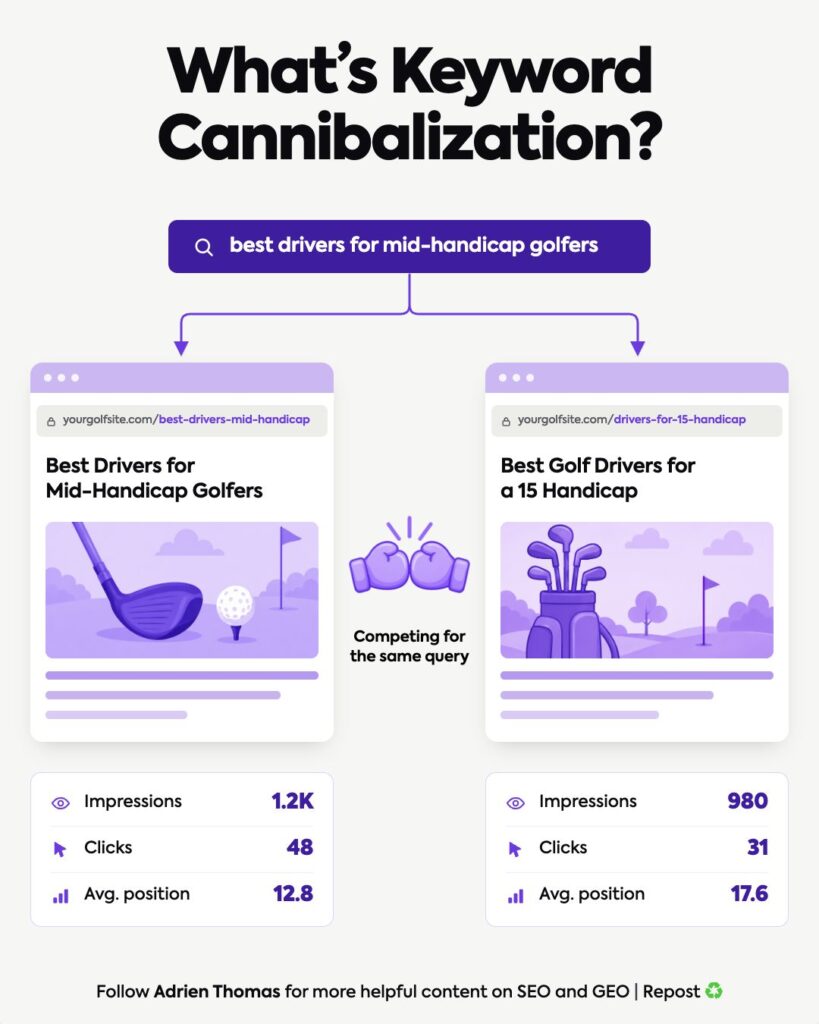
Take a golf equipment site. Someone searches “best drivers for mid-handicap golfers.” The site has 2 pages:
- Best Drivers for Mid-Handicap Golfers
- Best Golf Drivers for a 15 Handicap
Different titles, same commercial intent. A 15 handicap is a mid-handicap golfer. So instead of one strong page winning that search, 2 pages split it.
What Keyword Cannibalization Costs You
When 2 pages fight for the same intent, 3 things tend to go wrong.
Rankings get unstable. Watch the position-history chart for that query and you’ll see the pattern: URL A holds the top spot, URL B pushes it out, then A climbs back. Round and round, and neither one ever locks in the ranking.
Your signals split. Every backlink, every internal link, every page-level signal you’ve earned gets divided between 2 competing URLs instead of stacking behind one. Google says the same thing from its side. Its Search Central guidance is direct: leave overlapping URLs unconsolidated, and whatever ranking signal they’d built gets spread thin across all of them instead of concentrating in one place.
The reverse holds up too. Backlinko ran the experiment on itself: 2 cannibalizing pages, one 301 redirect, and clicks jumped 466% year-over-year within 8 weeks. The content stayed almost the same. What changed was which URL owned the intent.
Your content architecture gets muddy. There’s no single answer page anymore, just 2 contenders. Google can’t tell which one deserves the ranking, and your own team runs into the same wall: no one’s sure which URL to update, link to, or invest more work in.
The Same Problem Exists in AI Search
For GEO, the same ambiguity matters, and there’s even less room to work with.
Ask ChatGPT, Gemini, or Claude a question, and behind the scenes it’s pulling candidate pages, scoring them, lifting out the relevant passages, and crediting a short list of sources for the answer. A 2025 study on how generative engines cite sources, built around what researchers call the GEO16 framework, found these platforms surface only a handful of citations per answer, nowhere near the 10 blue links of a classic search results page.
Semrush has measured this from another angle: ChatGPT cites an average of 1.26 pages from a single domain per answer. That’s barely enough room for one of your pages, let alone 2 competing for the same claim.
Put your own cannibalization problem into that pipeline for a second. Several pages, one intent: which page do you actually want the model reaching for?
You don’t get a vote. The retrieval system picks for you, and 2 near-identical candidates from your own domain just make your strongest page harder to spot, for the algorithm and for whoever on your team is trying to figure out which URL to promote.
This is the part I keep repeating back to clients when an audit flags 2 of their own pages fighting each other:
“Almost every cannibalization case I look at comes down to the same root cause: a decision no one made. Two pages end up competing because no one decided, upfront, which one should own the intent. Make that call, and the technical fix, a redirect, a canonical, a sharper angle, takes minutes.”
That decision is also the whole answer to the next question: how do you actually catch this before it costs you anything?
How to Spot Keyword Cannibalization in Search Console
You can spot potential cannibalization in Google Search Console in a few minutes.
- Pick a query that actually matters to your traffic.
- Pull up the Pages report for it.
- See whether more than one URL is picking up impressions.
- Ask the real question: are these pages actually answering different intents?
That fourth question does all the real work. Multiple URLs picking up impressions only tells you there’s overlap. Whether that overlap is an actual problem comes down entirely to the intent check.
For a second opinion, pull up that query’s position history in your rank tracker. Two URLs trading the top spot back and forth is about as clear a cannibalization signature as you’ll find.
How to Fix Keyword Cannibalization: 3 Situations, 3 Answers
Which fix works depends on why the overlap exists in the first place.
| Situation | Fix | Why it works |
| Same intent, one page is clearly stronger | Merge the useful content into that page, then 301 redirect the weaker URL | Google’s documentation ranks redirects as the strongest consolidation signal available |
| Both pages earn their place independently | Differentiate the intent so each page answers a distinct question | Removes the overlap without giving up either page’s traffic |
| Near-duplicates that need to stay live | Add a canonical to indicate the main version | Google treats it as a strong hint, one step below a redirect |
In the golf example, the middle row plays out like this: one page keeps the mid-handicap driver picks, and the other becomes a fitting guide for players moving down from a 15 handicap. Same topic, genuinely different jobs.
Whatever you do, don’t start deleting pages on a hunch. Pick the page that should own the intent first. Then make sure everything around it says so too: the internal links pointing to it, the anchor text describing it, the sitemap listing it as the one that matters.
The Cheapest Fix Happens Before Publishing

Everything above this line is a repair. Prevention is cheaper than every one of those fixes, and it starts with 4 questions before a new page goes live:
- Do we already have a page targeting this intent?
- Would improving that page beat starting a new one?
- If we build a new page anyway, what makes its intent genuinely different?
- Which page do we want to be the main answer for this query?
No convincing answer to question 3 means one thing: the new page will be competing with the old one from day 1.
Semrush recommends building this into what it calls a keyword map: a spreadsheet that assigns one keyword, or one topic, to one canonical URL before anything gets published. It’s a small habit that catches most cannibalization before it happens. More content doesn’t automatically mean more visibility. Sometimes it just adds noise on top of what you already had.
Tracking Cannibalization Risk in Clairon
We kept running into this exact problem across client accounts at Crescendo, often enough that we built a dedicated tracking feature for it inside Clairon.
It flags the moment multiple pages from one website start competing for the same prompts, early enough that you can still decide: consolidate the pages, split the intent apart, or pick one and build it into the definitive answer.
That’s a plain SEO use case on its own. For GEO, it matters even more, for the exact reason covered here: if you’re trying to get one page recognized as the authority on a topic or a prompt, you need visibility into the moments your own site is quietly competing against itself.
Decide Which Page Owns the Intent
Most of the time, the pages themselves are fine. What’s missing is one decision: which page should own this intent? No one made that call, so the pages ended up competing by accident.
This week, run the Search Console check against your 10 most important queries. Any query where 2 URLs both show impressions, ask the intent question. Whatever the answer is, it tells you exactly what to do next.
FAQ
What is keyword cannibalization?
Keyword cannibalization happens when several pages on the same website target the same or very similar search intent and compete for the same keywords. Instead of one strong page, you end up with multiple weaker ones fighting each other from inside your own domain.
Is it a problem if 2 pages rank for the same keyword?
Only when both pages are chasing the same intent. If they answer different questions, ranking twice can actually work in your favor. Ahrefs reviewed 80 keywords with multiple ranking pages and found only 1 case that needed fixing. The real problem starts once both pages are doing the same job.
How do you fix keyword cannibalization?
It depends on why the overlap exists. If one page is clearly stronger, merge the content and 301 redirect the weaker URL. If both pages are genuinely useful, differentiate their intents. If near-duplicates need to stay live, a canonical can point to the main version.
Does keyword cannibalization affect AI search visibility?
Yes. AI platforms cite only a handful of sources per answer, and Semrush has measured ChatGPT citing as few as 1.26 pages from a single domain. When several of your pages cover the same intent, the retrieval system has to pick between near-identical candidates, and you lose control over which page ends up representing you.
How do you find keyword cannibalization in Google Search Console?
Pick an important query, open the Pages report, and check whether multiple URLs are picking up impressions for it. Then ask whether those pages genuinely serve different intents. Only same-intent overlap counts as real cannibalization.