
TL;DR
- Anchor text is the clickable words inside a link, the only part that tells a reader or Google what’s waiting on the other side.
- “Click here,” “read more,” and “learn more” send someone somewhere without saying where. Google names these as its own examples of anchors that are too generic.
- A descriptive anchor does 3 jobs at once: the reader knows what’s coming, Google gets context on the destination, and the connection between your pages becomes visible.
- Natural variations of the same phrase count as descriptive anchors. Forcing the exact keyword into every link is the mistake Google’s own guidance warns against.
- The same anchors that clarify a page for Google clarify it for AI Overviews and AI Mode too, since both run on Search’s existing systems.
So, what is anchor text? It’s the visible, clickable text inside a hyperlink, the words a reader sees and clicks instead of a bare URL.
Take 2 links pointing to the same guide, “Best Drivers for Mid-Handicap Golfers.” The first says “click here.” The second says “best drivers for mid-handicap golfers.”
Same destination, and only one of them tells the reader and Google what’s actually there. A site full of the first kind of anchor hands every reader and every crawler the same empty label, page after page.
What Is Anchor Text?
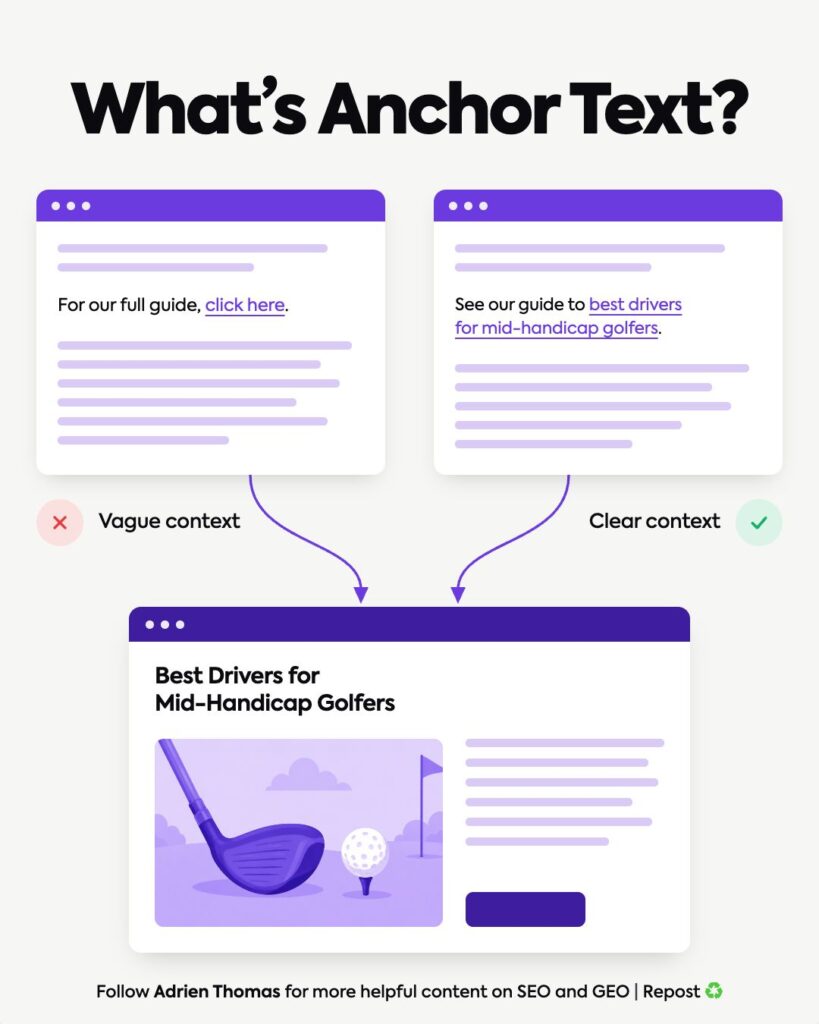
In HTML, anchor text is whatever sits between the <a> tags. Google’s own documentation describes it as text that “tells people and Google something about the page you’re linking to.”
The example above makes this concrete. It uses 2 links pointing to the same page, a guide to the best drivers for mid-handicap golfers.
The first anchor says “click here.” The second repeats the topic of the page.
Same webpage, a different amount of context handed to whoever, or whatever, follows the link.
One detail worth knowing: when an image is the link, Google reads the image’s alt attribute as the anchor text. So a line of code like this:
<a href=”/golf-drivers”><img alt=”Best drivers for mid-handicap golfers”></a>
still tells Google what’s behind the link. An image link with empty alt text tells it nothing. Google also falls back on the title attribute when the visible link text is empty, one more reason a strong alt tag earns its keep.
Anchor text comes in a handful of recurring types. Yoast’s SEO glossary and Ahrefs’ anchor text glossary sort them roughly the same way:
| Anchor text type | Example | What it tells Google |
| Exact-match | “best drivers for mid-handicap golfers” | The destination’s exact target phrase |
| Partial-match or related | “drivers for mid-handicap golfers” | A close variation of the topic |
| Branded | “Crescendo’s driver guide” | The publisher, not the topic |
| Naked URL | “crescendoagency.ai/blog/best-drivers” | The address, and little else |
| Generic | “click here,” “read more” | Nothing about the destination |
| Image (alt text) | alt=”Best drivers for mid-handicap golfers” | Context read from the attribute instead of visible text |
Most sites lean on 2 or 3 of these without noticing: branded links in the navigation, naked URLs in a footer, generic anchors wherever an editor was in a hurry. The type that carries the least information is also the one that shows up the most.
Why “Click Here” Wastes Context
Google’s own anchor text best practices name 4 examples of anchors that are too generic: “Click here,” “Read more,” “website,” and “article.” On the sites we audit at Crescendo, these cluster in blog teasers and calls to action.
Google crawls a generic anchor exactly like it crawls any other link, and a reader clicks it just the same. What goes missing is the context, and that context carries 3 jobs.
- It helps the reader. People decide whether to click based on the words inside the link. “Best drivers for mid-handicap golfers” tells them what’s coming; “click here” leaves them guessing.
- It gives Google context. Anchor text is one of the signals Google reads to work out what a destination page covers. A site where every internal link says “read more” hands Google the same label for every page it touches.
- It clarifies internal linking. Descriptive anchors show how related pages connect: a guide on drivers linking to “most forgiving golf drivers” and “how to stop 3-putting” tells a reader, and Google, how those 2 pages relate. The same guide linking to “learn more” 3 times tells Google nothing beyond the fact that 3 links exist.
Google’s own test for this is simple, and it’s the one I use with clients: read the anchor text on its own, with the rest of the sentence covered up. If you can’t tell what the page is about from those words alone, rewrite them.
The data backs this up. Cyrus Shepard’s study for Zyppy looked at 23 million internal links across 1,800 sites and found that anchor text variety correlated with search traffic. Pages with at least 1 descriptive, exact-match internal anchor saw around 5 times the traffic of pages without one.
Shepard is upfront that the study shows correlation. He doesn’t claim it proves causation. Even so, it lines up with what Google’s own documentation asks for.
Descriptive Doesn’t Mean Exact-Match
Anchor text SEO mistakes rarely stop at “click here.” A team hears “use descriptive anchors,” and the very next sprint, the target keyword gets pasted into every internal link, word for word.
Google is direct about this: write anchor text as naturally as you’d write anything else, and if it feels like you’re forcing keywords into it, you’re overdoing it. Keyword stuffing inside anchor text falls under Google’s spam policies, the same rules that govern the rest of the page.
Here’s how Google frames it, on the same page this whole argument comes from:
“Exact-match anchor text is not always better. For internal links, you don’t need to repeat the exact same keyword every time. Natural variations usually make more sense: most forgiving drivers, drivers for mid-handicap golfers, easier-to-hit golf drivers. And for backlinks, too many exact-match commercial anchors can start to look manipulative. The goal is simple: describe the destination clearly, without forcing the keyword.”
All 3 of those variations point at the same page. The wording moves and the context stays intact.
Zyppy’s data points the same way. Shepard’s numbers show exact-match once, then variety after, both correlating with more traffic. In practice, that means using a page’s target phrase in 1 anchor, then describing that same page in different words everywhere else.
For backlinks, the stakes go up: Google’s spam policies list “links with optimized anchor text in articles, guest posts, or press releases distributed on other sites” as an example of link spam. A backlink profile where most anchors repeat the same commercial phrase reads like a pattern built for a single purpose: ranking. That’s exactly what the policy is written to catch.
What Anchor Text Does for GEO
Internal links help AI crawlers connect your pages around a topic, and anchor text is the label on that connection.
For Google’s AI features, this isn’t a guess. Google’s May 2026 guide to optimizing a website for generative AI features states that AI Overviews and AI Mode run on the same core Search ranking and quality systems. Both pull pages from the Search index through retrieval-augmented generation and query fan-out.
What is anchor text worth in that system? The same as it’s worth in regular Search. If descriptive anchors help Google understand a page for Search, they help for AI Overviews and AI Mode too, because there’s no separate system behind them to convince.
The same guide adds that Google’s AI systems understand synonyms and general meaning, so you don’t need to capture every possible phrasing of a keyword. One more argument for natural variation over repeating the same exact-match phrase.
For ChatGPT, Claude, and Perplexity, the picture is less documented, and I’d rather say that plainly than guess:
“I won’t claim anchor text is a ranking factor for ChatGPT, Claude, or Perplexity. None of the crawler documentation I’ve read says how they weigh it. What I can say with confidence: a crawler that follows your internal links reads the anchor as it goes, and ‘most forgiving golf drivers’ tells it more about the destination than ‘click here’ does.”
Adrien Thomas, co-founder of Crescendo
That’s as far as the current evidence goes. Descriptive anchors cost nothing extra to write, and there’s no crawler on that list they could plausibly hurt.
The Anchor Text SEO Checklist: 4 Checks Before You Add a Link

These 4 questions are the anchor text best practices we use inside Crescendo’s own internal linking audits. Before your next internal link goes live, run the anchor through all 4.
- Does the anchor describe the page it points to? If the words could lead anywhere, rewrite them.
- Would it still make sense on its own, without the rest of the sentence? This is Google’s out-of-context test. “Best drivers for mid-handicap golfers” passes; “this guide” doesn’t.
- Does it read naturally? If the sentence had to bend to fit a keyword, the anchor is forced, and readers notice forced writing even when they can’t name why.
- Does the reader actually need this link? A well-written anchor can’t rescue a link that had no reason to exist.
If the answer to all 4 is yes, add the link. If even 1 comes back no, fix that one first.
Closing Thoughts
A URL tells a browser where to go. Anchor text is the only part of the link that tells a reader, and every crawler that follows it, what’s actually there.
A site full of “click here” still works but none of those links say where they lead. Fixing that costs a few words per link and iIt doesn’t require a redesign.
At Crescendo, anchor text is part of every internal linking audit we run, for SEO and GEO in the same pass. The pattern repeats across almost every site we look at: generic anchors on the pages that matter most, and exact-match anchors pasted in wherever someone already tried to fix it.
Both get replaced with the same thing: anchor text that describes the destination in words a person would actually use.
FAQ
What is anchor text?
Anchor text is the clickable text of a hyperlink, the words between the <a> tags in HTML. It tells a reader and a search engine what the linked page covers before anyone clicks.
Why is “click here” bad anchor text?
It describes the act of clicking and says nothing about the destination. Google names “click here” and “read more” as its own examples of anchors that are too generic.
What makes good anchor text?
Google defines it as anchor text that’s descriptive, reasonably concise, and relevant to both the page it sits on and the page it links to. A quick check: read the anchor alone. If it still makes sense without the rest of the sentence, it qualifies.
Does anchor text affect SEO?
Yes. Google uses links and their anchor text as signals for understanding what a page is about. Cyrus Shepard’s Zyppy study of 23 million internal links found that anchor variety, and at least 1 exact-match anchor per page, both correlated with higher search traffic.
Should internal links use exact-match anchor text?
Once per page is usually enough. Use a page’s target phrase in 1 anchor, then describe the same page with natural variations everywhere else. Forcing the exact keyword into every link falls under Google’s keyword stuffing policy.