
TL;DR
- An AI citation means your website gets used as a source. An AI brand mention means your brand name appears inside the answer.
- The two signals are related, and they often show up separately.
- 62% of the time, a website gets cited without the brand being named in the response.
- Only 13.2% of domains earn both: cited as a source and mentioned in the answer.
- Each AI platform behaves differently. Strong visibility on Gemini says nothing about your visibility on ChatGPT.
When an AI platform pulls from your website to build an answer, that’s a citation. When your brand name shows up inside that answer, that’s a brand mention.
As a GEO Agency, this is exactly the kind of gap we help brands close. Your content can do the work while a competitor’s name gets the recommendation.
What AI brand mentions and AI citations actually are
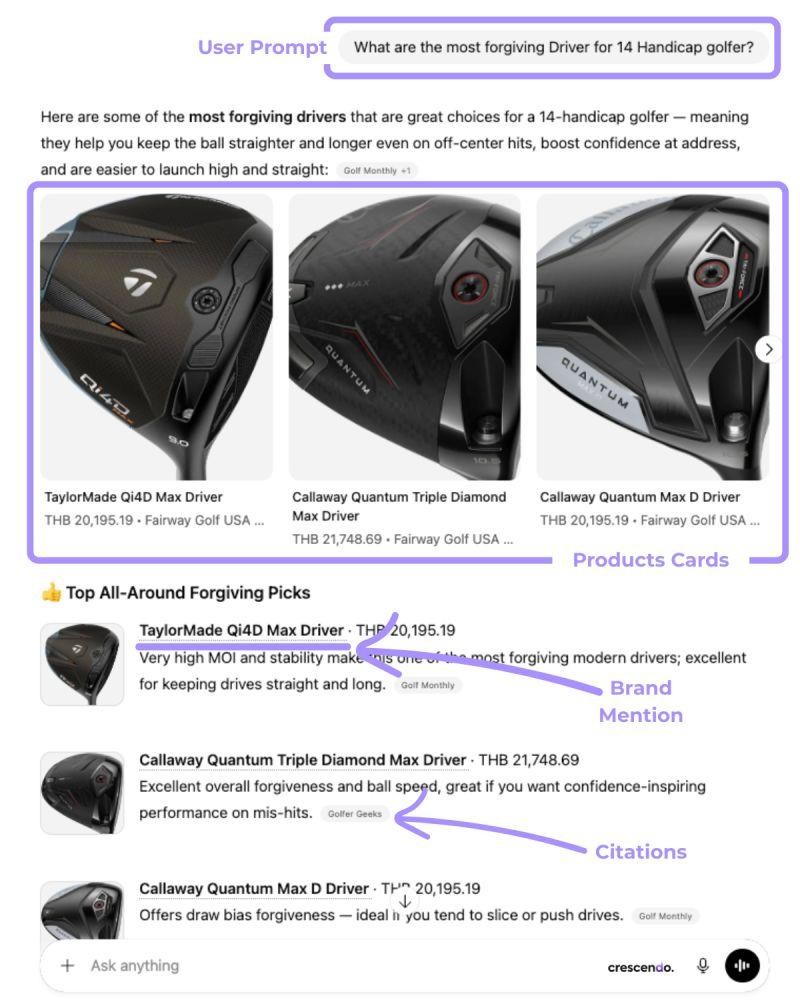
The two terms get conflated constantly, so precision first:
- An AI citation, sometimes called an LLM citation, is when an AI platform references your website as a source. Your domain appears as a footnote, a source link, or an attribution. The model is saying: this is where the information came from.
- An AI brand mention is when your brand name appears in the body of the answer itself. The model is saying: this company is relevant to what you asked.
Both can happen in the same response. Each can also happen alone.
And that’s the problem: your website can feed an answer while your brand stays invisible inside it.
The gap between being cited and being recommended
The data on this split is now well documented.
- 62% of the time, a website gets cited as a source without the brand being named in the answer. The content does the work, the brand skips the credit.
- Only 13.2% of domains earn both signals: cited as a source and mentioned in the response.
Semrush formalized this dynamic in September 2025 under the name “Mention-Source Divide.” AirOps quantified it from another angle: brands are 3 times more likely to be cited alone than to earn both signals in the same response.
The practical version looks like this. A prospect asks ChatGPT: “What’s the best project management software for remote teams?” The answer names Asana, Monday.com, and ClickUp. At the bottom, it cites your comparison guide as a source. Your content informed the answer but your competitors collected the recommendation.
A citation remains a positive signal: it means AI platforms judge your content credible and relevant enough to draw from.
It just carries far less commercial weight than a brand recommendation inside the answer, because people read the answer, register the named brands, and rarely scroll down to the source links.
Why each platform behaves differently
The citation and mention split changes shape depending on the platform you’re tracking.
| Platform | Mention rate | Citation rate | Behavior |
| Gemini | 83.7% | 21.4% | Names brands confidently in the answer body, links out less systematically |
| ChatGPT | 20.7% | 87% | Cites heavily, selective about which brands it names |
| AI Overviews / AI Mode | Between the two | Between the two | Leans toward citations |
The architecture explains the ChatGPT pattern. ChatGPT brand mentions stay rare because the platform synthesizes from many sources through its Bing integration (for live search, 87%+ of citations come from Bing’s top results), pulling review sites, directories, and third-party content into answers that cite plenty without crowning a single brand.
A Gemini mention, by contrast, is a strong signal precisely because Gemini names brands more freely than it links.
The differences run deep enough to reshape strategy:
- A playbook built for one platform won’t transfer automatically to other engines.
- Ahrefs found only 13.7% of citations overlap between AI Overviews and AI Mode, two Google products.
- Separate research found roughly 11% domain overlap between ChatGPT and Perplexity for identical questions.
- Same question, almost entirely different source pools.
One nuance from newer research sharpens the picture rather than softening it. Ahrefs measured a 0.75 to 0.82 correlation across engines on which brands get mentioned, even while the cited domains barely overlap.
Put simply: platforms disagree about sources and largely agree about brands. The divide between citations and mentions shows up again at the platform level, and it favors brands strong enough to be named everywhere.
The commercial consequence
When a user asks an AI for a recommendation and receives a named list of brands, attention lands there. The source links at the bottom, when they appear at all, stay secondary.
The user sees one thing: which brands got recommended, but the machinery behind the answer stays invisible. If your brand sits outside the answer, the citation wins you nothing in that conversation.
AirOps found that brands earning both signals are 40% more likely to resurface across consecutive AI search queries than brands earning citations alone. Dual-signal visibility compounds. Citation-only visibility stays fragile.
None of this makes citations worthless. They’re a legitimate first step and a sign your content clears the trust bar. They’re the floor. Mentions are what you build on top of it.
What this means for your AI visibility strategy
Three practical directions follow.
Platform-specific strategy
- Gemini rewards brands publishing structured, authoritative content on their own domain.
- ChatGPT rewards brands that appear often across third-party sources: reviews, directories, community discussions.
- The same approach won’t cover both, and visibility on one platform transfers to nothing, which is exactly why multi-platform capability belongs on any agency-vetting checklist.
Brand presence beyond your website
- 85% of brand mentions in AI answers come from third-party pages, off owned domains.
- Reddit, YouTube, LinkedIn, and G2 rank among the most-cited sources across ChatGPT, Gemini, and Perplexity.
- LinkedIn is currently the single most-cited domain for professional queries across major AI platforms, having jumped from outside the top 20 into ChatGPT’s top 5 within months.
- G2 is the most-cited software review platform on ChatGPT, Perplexity, and AI Overviews. Seer Interactive’s study of 800K AI responses found review profiles correlate with higher citation rates across every platform and vertical they measured.
- Seer’s earlier research adds a driver worth knowing: brands ranking on page 1 of Google showed a strong correlation (around 0.65) with LLM mentions, while backlinks showed weak to neutral impact. Classic SEO rankings still feed AI mentions. Link volume alone doesn’t.
- A brand that barely exists in these spaces gives AI platforms little reason to name it confidently in their answers.
Tracking both metrics separately
- Citation rate and mention rate are different marketing KPIs. Track both, broken down by prompt, country, and AI platform. Continuous monitoring beats one-off checks.
- High citation rate with low mention rate means your content is trusted while your brand stays invisible. That usually signals an off-site presence problem, and no amount of on-site content fixes it.
- Tools like Clairon track this split across platforms and prompts, showing where the gap sits and what drives it, the same kind of question a proper AI visibility audit is built to answer.
Citations and mentions respond to different work in AI Search. Citations are mostly an on-site and technical problem. Mentions depend heavily on what exists about your brand outside your own website.
Final Thoughts
Citations tell you AI platforms trust your content. Mentions tell you they recommend your brand. Tracking the two as a single number hides the exact gap that decides who gets considered.
This split is one of the first things we look at in every AI visibility audit at Crescendo, because it shows immediately whether a brand has a content problem or a presence problem, and the two get fixed in very different ways.
FAQ
-
What is an AI brand mention?
An AI brand mention is when your brand name appears in the body of an AI-generated answer. The model names your company as relevant to the question asked, with or without linking to your site.
-
What is an AI citation?
An AI citation, or LLM citation, is when a generative AI platform references your website as a source, usually through a link, footnote, or attribution. It signals the model found your content credible enough to draw from.
-
Can a brand be cited without being mentioned?
Yes, and it’s the most common outcome. 62% of the time, websites cited as sources see no brand mention in the answer itself. Your content informs the response while a competitor’s brand gets recommended in it.
-
Why do Gemini and ChatGPT behave so differently?
Gemini names brands freely in the answer body with fewer source links. ChatGPT cites heavily, largely through Bing’s top results, while staying selective about the companies it names. Different retrieval architectures produce different visibility patterns for the same brand.
-
How should you track AI citations vs mentions?
Separately, ideally in a dedicated tool, broken down by prompt, AI platform, and country. High citations with low mentions points to an off-site presence problem. Low citations across the board points to a content authority or technical issue.